OOTDly
Carmen Miranda
Before she sang she made hats, and ended up wearing a fruit bowl on her head.
She was born in 1909 in Marco de Canaveses, Portugal, and arrived in Rio de Janeiro before her first birthday. As a young woman she worked in a hat shop, where she learned the trade. She stood just over five feet tall, and in Brazil they called her “A Pequena Notável”, the remarkable little one.
In the film “Banana da Terra”, released in 1939, she appeared for the first time dressed as a baiana to sing “O que é que a baiana tem?”, by Dorival Caymmi. The costume came from the women who sold food in Rio’s Praça Onze. The turban she made herself: according to the Museu Carmen Miranda, she designed most of the ones she wore.
That same year, the impresario Lee Shubert saw her perform at the Cassino da Urca and signed her for Broadway. In May 1939 she sailed for New York and in June she opened in “The Streets of Paris”. According to the museum, actresses and many other women copied her turbans, especially during the war.
To gain height she wore platforms, which the museum links to Portuguese clogs. The Ferragamo Museum in Florence keeps a 1939 sandal created for her.
In July 1940 she returned to Rio and was received coldly. One newspaper wrote that she had spoiled Brazilian music by filling it with American things. She answered with a song: “Disseram que voltei americanizada”, they said I came back Americanised.
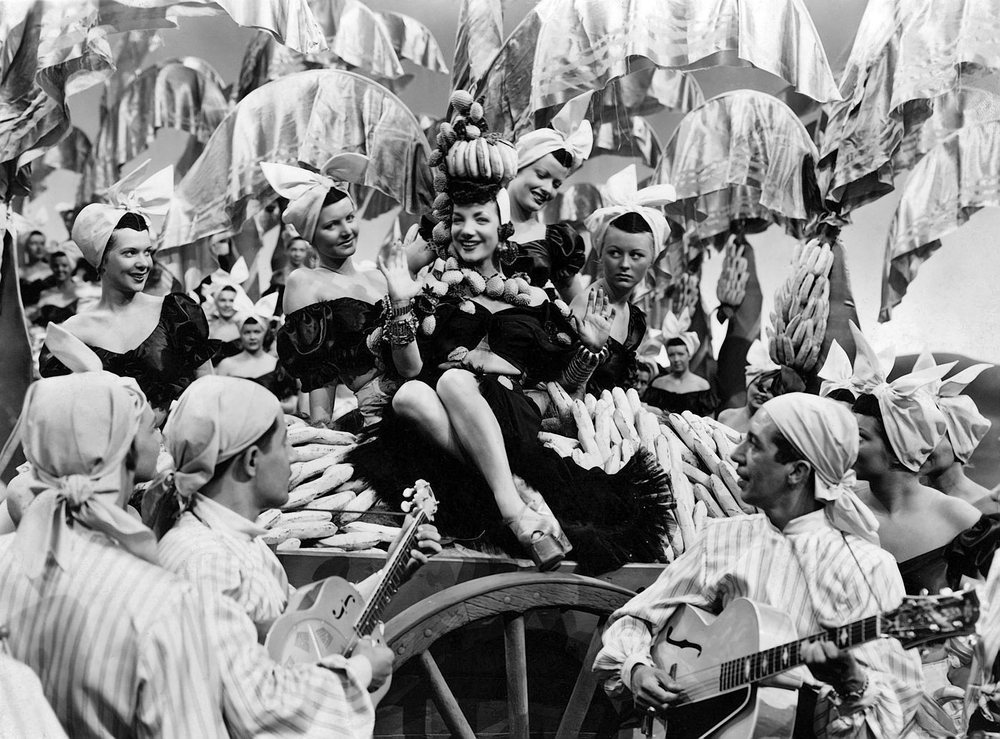
In 1943 she shot “The Gang’s All Here”, with the number “The Lady in the Tutti Frutti Hat”, among chorus girls and giant bananas. In the mid-forties she was the highest-paid woman in the United States, earning more than 200,000 dollars a year. She died on 5 August 1955 in Beverly Hills, aged 46. The museum that bears her name, in Rio’s Aterro do Flamengo, holds more than 3,000 pieces.