OOTDLYTu estilo. Tu vibra. Tu mundo.

Fashion culture

OOTDly

What you’re wearing has a story.

Every story, with its sources. Each new one is added here.

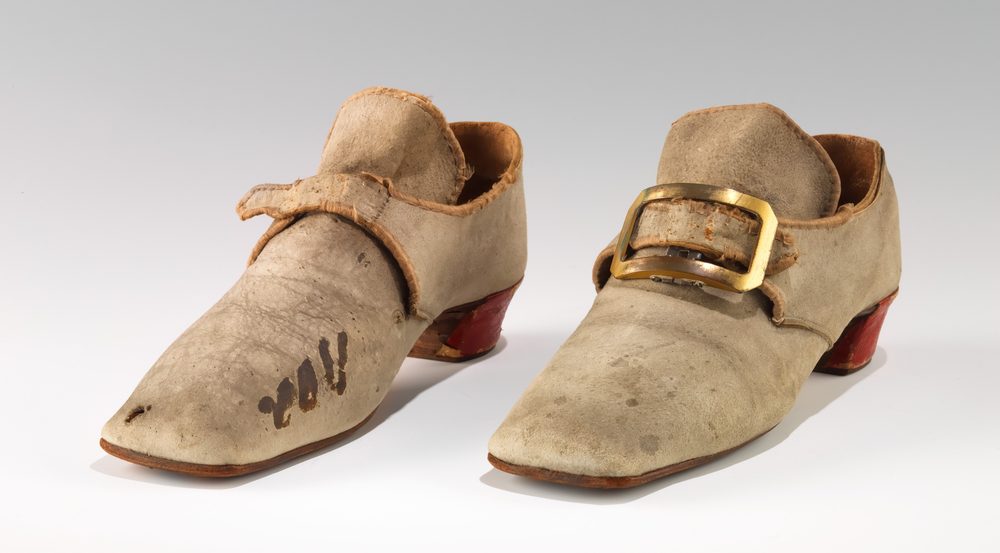
A pair of pale suede shoes with square toes, a gold buckle and red heels.
Photo: The Met, public domain.

The red heel

High heels were men’s shoes, and red told everyone who you were.

The heel wasn’t born to look pretty: it came from Persia, where it was riding footwear. The heel locks the foot in the stirrup and lets the rider stand up in the saddle to shoot.

Around 1600 it reaches Europe as a men’s thing: cavalry, strength, status. Women take it up soon after, in the 1620s, precisely because it was a masculine code.

Read the whole story

At the court of Louis XIV, the red heel became the mark of a noble presented to the king. The Académie française dictionary records “talon rouge” with that meaning: a noble of the court.

Here’s what almost every fashion video gets wrong: there is NO 1673 edict banning red heels for commoners. No one has ever found that document. It was court custom, not law.

The privilege that did exist, this one in writing from the king, was something else: the “justaucorps à brevet”, a blue coat lined in red for some sixty people allowed to accompany the king.

In Rigaud’s 1701 portrait, Louis XIV is 62 and wears square-toed shoes with red heels, soles and tongues, fastened with diamond buckles. The painting hangs in the Louvre and is 2.77 m tall.

And it was men who gave up the heel, around 1730 — half a century before the French Revolution, contrary to what is usually said.

In 1799 Napoleon summed it all up: “neither red cap nor red heels: I am national.” Ten years after the Revolution, the red heel still meant aristocrat.
Open this story

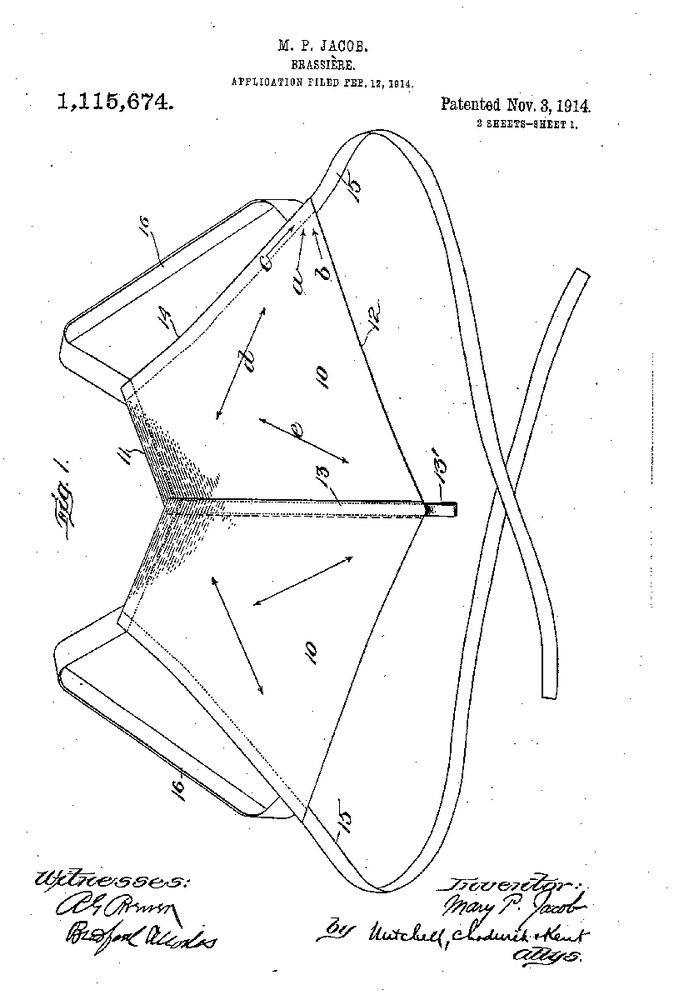
Drawing from Mary P. Jacob’s US patent 1,115,674, “Brassiere”, 1914.
US Patent 1,115,674, 1914. Public domain.

The bra

She didn’t invent the bra. What she did was something else, and it’s better.

February 12, 1914: Mary P. Jacob files for US patent 1,115,674. The printed title is a single word: “Brassiere”.

It isn’t the first garment of its kind — it’s the first US patent to carry that name. Earlier ones were filed as “breast supporter”, “bust supporter”, “corset cover”. There were at least six before it, one from 1893.

Read the whole story

And much earlier: in 2008 an excavation at Lengberg Castle, in Tyrol, turned up linen garments with cut cups. Carbon-dated to the 15th century.

The patent’s case isn’t aesthetic, it’s practical: a garment “backless, so it does not interfere with any style of evening gown”.

She sold the patent to Warner for $1,500. The factory made the model for one season and dropped it for lack of sales. Her own company didn’t take off either.

Then she changed her name and her life. As Caresse Crosby, she set up the Black Sun Press in Paris and published James Joyce in 1929 and D. H. Lawrence the same year.

Time magazine, in its 1970 obituary, called her the literary godmother of the Lost Generation.

The patent says “Mary P. Jacob”. She only took the name she became known by ten years later.

Open this story

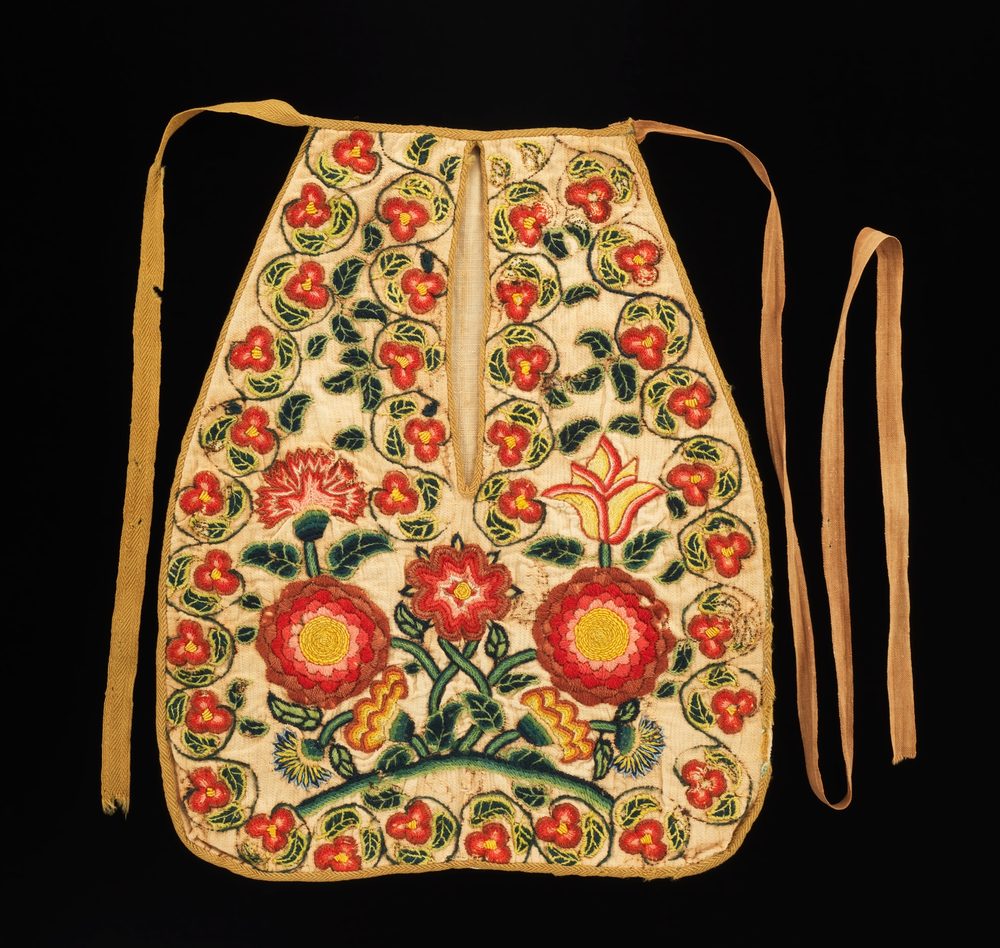
Embroidered tie-on pocket with floral motifs and its waist ties.
Embroidered tie-on pocket. Photo: The Met, public domain.

The pocket

For two centuries, a woman’s pocket was a bag tied around her waist, under her skirt.

It wasn’t sewn into the clothes. It was a separate piece, tied on with a string, reached through slits in the seams of the skirt and petticoat. You wore one, two or three at a time.

And they were big: most surviving ones measure about 40 by 30 cm. The largest on record is 61.5 by 43.5 cm — bigger than the biggest Birkin.

Read the whole story

Inside: keys, coins, jewelry, a watch, a thimble, a letter, a miniature portrait. Working women carried the tools of their trade.

That mattered. Under English law, a married woman couldn’t own property of her own until the property acts of the 1880s. The bag tied at her waist was the safe she had.

Two historians found 572 Old Bailey court cases for theft of these pockets.

Around 1800 dresses slimmed down, fabric got lighter and the bag no longer fit underneath. Enter the handbag: the “reticule”, from the Latin reticulum, little net.

But one didn’t replace the other — that story is too neat. The two lived side by side for almost a century; the tied pocket just changed its trade name, becoming the “money apron” or the “travelling pocket”.

What never came back was the sewn-in pocket. In 2018, 80 pairs of jeans from 20 brands were measured: an average depth of 14.3 cm in women’s against 23.1 in men’s.

Only 40% of women’s front pockets fit a phone from the three leading brands. And the average price is the same: $80 against $81.

Open this story

Marc Jacobs, bearded, his curly hair tied back with a black bow, in a black jacket with satin lapels and a black V-neck jumper, against a white background.
Photo: Harald Krichel, CC BY-SA 4.0.

Marc Jacobs

He was fired for dressing the street, and five years later he was handed Louis Vuitton.

In 1992 Marc Jacobs brought grunge to the Perry Ellis runway. The collection was cancelled, never reached the shops, and he was fired.

3 November 1992: Nirvana and Pearl Jam as references at an American knitwear label. The executives didn’t forgive it. Today the collection is studied as a landmark of the nineties.

Read the whole story

What scared Perry Ellis was exactly what caught Bernard Arnault’s eye. In 1997 he became the first creative director in Louis Vuitton’s history. He was 33.

The house was 144 years old and had never sold clothes: only trunks and bags. Louis Vuitton’s first ready-to-wear dates from March 1998, and he built the division from scratch.

In 2001 he let Stephen Sprouse scrawl over the monogram in neon. In 2003 he did it again with Takashi Murakami: thirty-three colours.

He left in 2013, after sixteen years, with Vuitton at the top of the world’s most valuable luxury brands.

Open this story

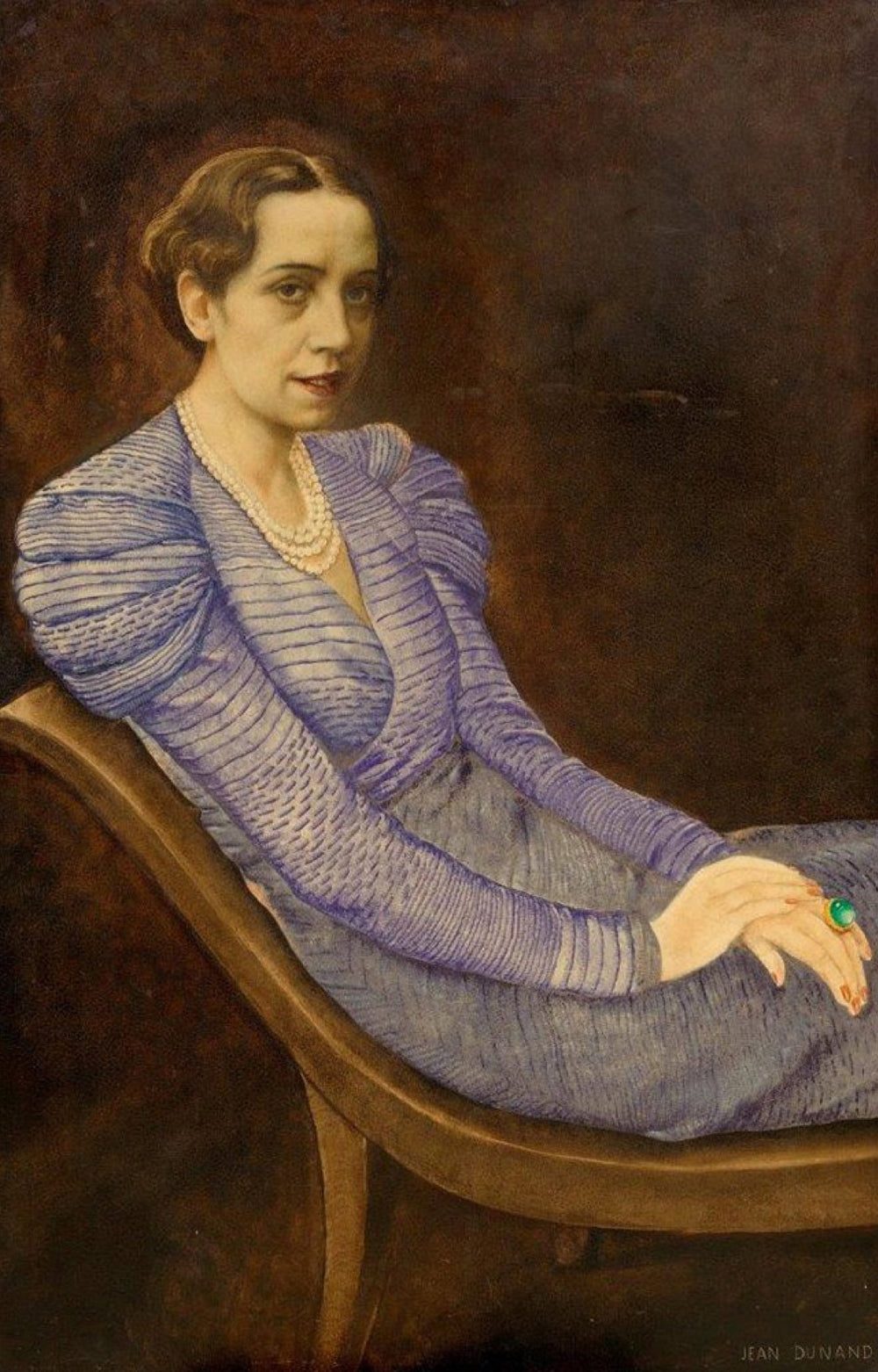
Painted portrait of a woman with short brown hair reclining on a wooden chaise, in a lavender dress with puffed sleeves, a multi-strand pearl necklace and a green ring, against a dark brown background.
Portrait of Elsa Schiaparelli by Jean Dunand. Musée des Arts Décoratifs, Paris. Public domain.

Elsa Schiaparelli

Coco Chanel refused to say her name. She called her “that Italian who makes clothes”.

Elsa Schiaparelli hit back with a single word: “that milliner”. The rivalry that split 1930s fashion.

Born in Rome in 1890, she arrived in Paris in 1922 with no money and no idea how to cut a pattern.

Read the whole story

In 1927 she knitted a black sweater with a white bow worked into the knit itself: a trompe-l’œil, not a sewn-on bow. Vogue published it. A New York store ordered forty. The house was born from that.

In 1931 Lili de Álvarez walked onto Wimbledon in one of her divided skirts, and the press treated it as a scandal. She was also one of the first to put a visible zip on a couture garment, when zips were for boots.

She brought Dalí, Cocteau and Man Ray into the clothes: the 1937 lobster dress that Wallis Simpson wore, the hat shaped like a shoe.

She saw Daisy Fellowes’s 17-carat pink diamond and took a colour from it. She called it Shocking and gave the perfume the same name, in 1937, in a torso-shaped bottle. The pink is still the house’s signature.

Two women, two opposite ideas of fashion: Chanel stood for elegance and comfort; Schiaparelli, for clothes as art and as provocation. The story goes that at a ball Chanel asked her to dance and steered her into a lit candelabra; the dress caught fire and was put out with soda water. The teller is Bettina Ballard, a Vogue editor.

She closed the house in 1954 and died in 1973 without seeing it reopen. Today Schiaparelli dresses the entire red carpet.

Open this story

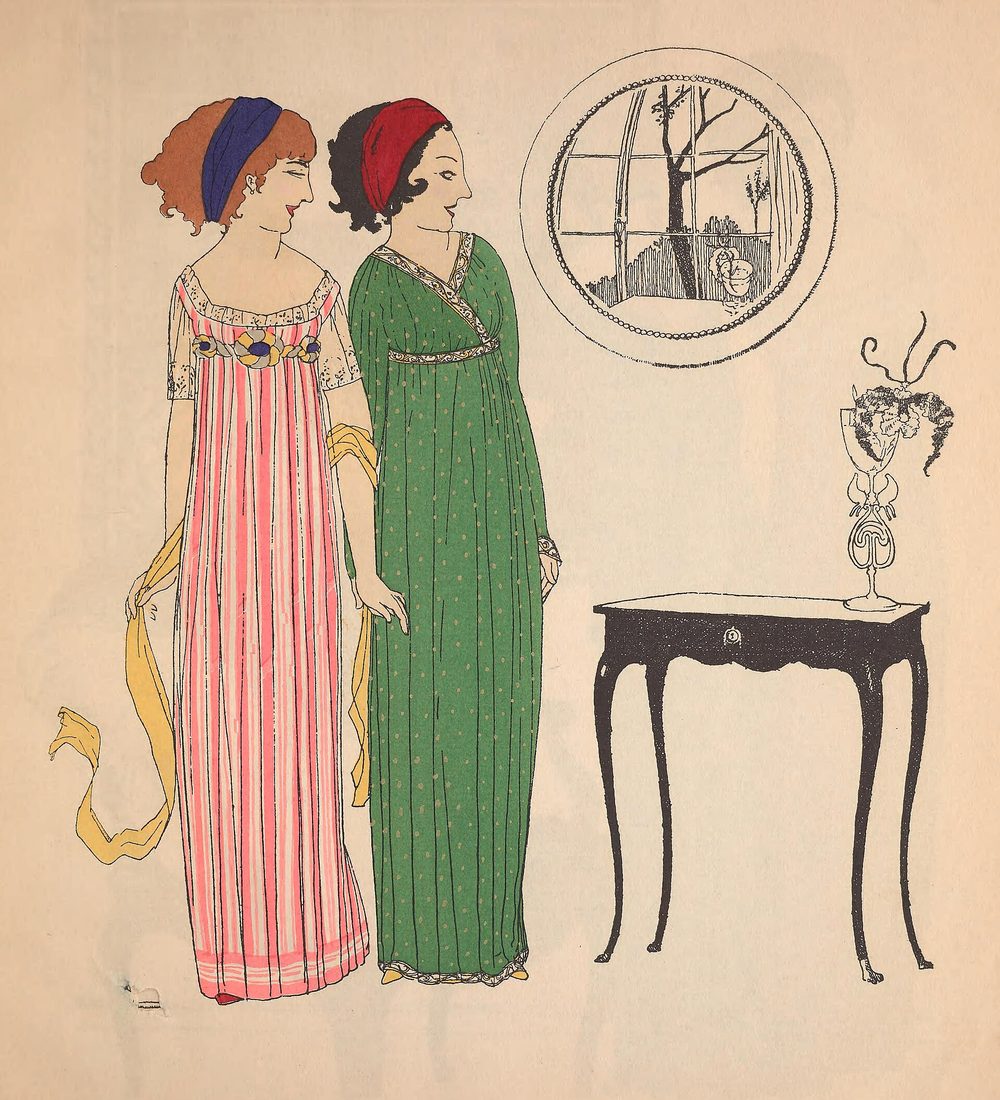
Illustrated plate: two women standing in long high-waisted dresses, one pink-striped with a yellow shawl and one green, beside a small table with a vase and a round frame showing trees on the wall.
Plate by Paul Iribe for “Les Robes de Paul Poiret”, 1908. Public domain.

Paul Poiret

He sold the idea that he had freed women from the corset, and then launched the skirt that made it impossible to walk.

Paul Poiret, Paris. On 24 June 1911 he threw the Thousand and Second Night party: 300 guests in costume at his home, and he came as a sultan.

In his memoirs, from 1930, he says his wife, Denise, waited for the guests inside a golden cage, surrounded by ladies singing Persian arias. The source for that scene is him. The museum that now holds his work doesn’t even mention it.

Read the whole story

The line everyone repeats is that he abolished the corset. In 1906 the promotional material for his own collection still shows the corset underneath, and other houses were already loosening the waist before him.

And the corset didn’t disappear: it was replaced by the bra and the girdle. One garment was swapped for two.

In 1911 he launches the “jupe à l’entrave”, the hobble skirt: so narrow at the bottom that it shortened your stride. The house that sold freedom put out the garment that most restricted walking all century.

He wrote it himself: “I freed the bust, but I shackled the legs.”

His couture house closed in 1929. He died in Paris on 30 April 1944, ruined and forgotten.

Open this story

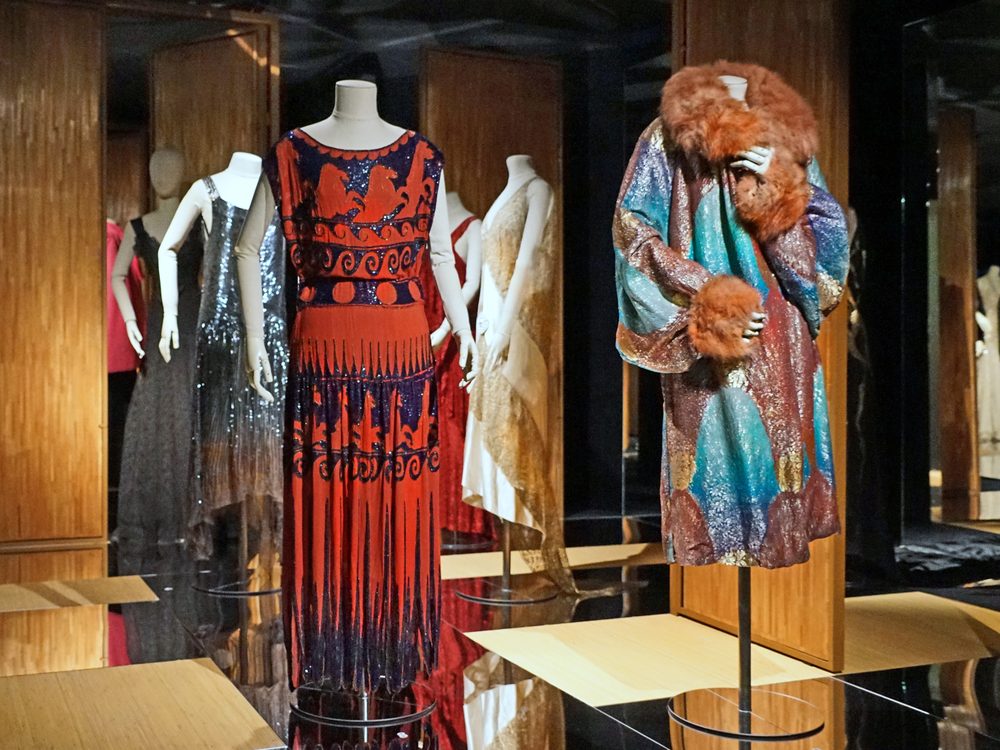
Garments on mannequins in an exhibition room with wooden panels: in the centre, a red dress embroidered with horses and waves in blue; on the right, an iridescent coat with a fur collar and cuffs; behind, a silver sequinned dress and a white one.
Photo: Jean-Pierre Dalbéra, CC BY 2.0.

Madeleine Vionnet

She didn’t invent the bias cut. She did something harder: she built the whole dress with it.

Cutting fabric on the diagonal already existed, but it was used for details: collars, ruffles, bias binding. Madeleine Vionnet was the first to rethink the entire garment from that technique.

Cut this way, the fabric stretches and springs back, follows the body and falls on its own. It needs no corset underneath to hold the shape: the shape is in the cut.

Read the whole story

And she didn’t sketch first. She draped straight onto an articulated wooden mannequin 80 cm tall, at reduced scale, and only then reproduced it at full size. She thought of clothes in three dimensions, like soft sculpture.

Her house, opened in 1912, offered paid holidays, maternity leave, a crèche, a doctor and a dentist on site. French law only made paid holidays compulsory in 1936.

Against copies, she set up a system: every model photographed from three sides and filed in registration albums, and her own fingerprint applied to the label sewn into every garment.

It didn’t work. A Paris museum holds an unauthorised copy of the “Little Horses” dress, from 1924. She spent her life in lawsuits.

And that story about her being inspired by watching Isadora Duncan dance barefoot? It has no source. What is documented is the opposite: in 1923 Isadora Duncan was her client.

Open this story

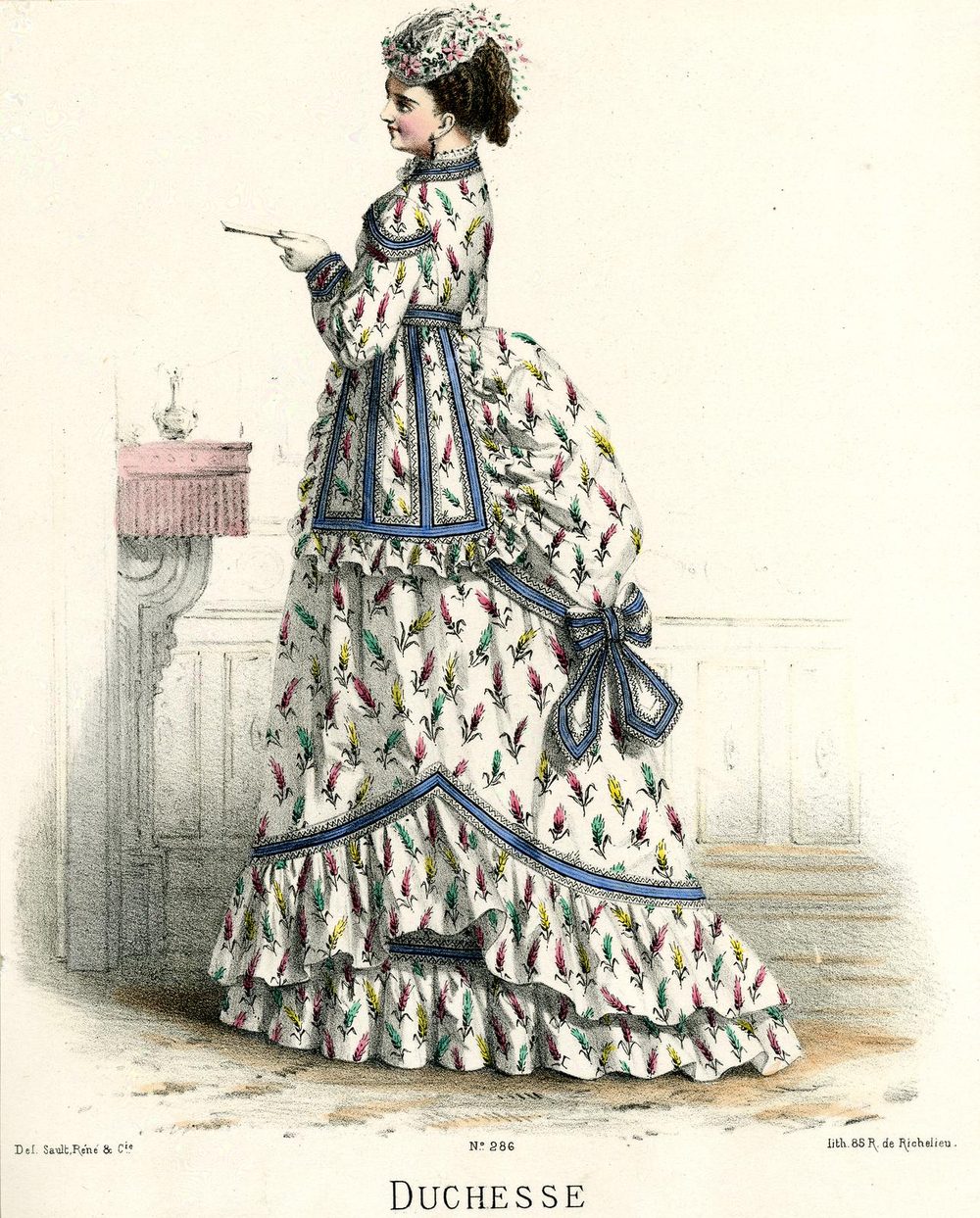
Hand-coloured fashion plate: a woman in profile in a white dress with colourful motifs and blue trim; a panel springs from the waist and falls over the skirt, with a bustle and a large bow at the back.
Plate “Duchesse”. Photo: British Museum, public domain.

The peplum

The peplum never cinched anything.

The flare that springs from the waist comes back every season. And the trick was never in the waist.

It comes from the Greek peplos: a length of cloth fastened at the shoulders, with so much left over that it had to be gathered up. That gathered fold is the whole invention.

Read the whole story

Magazines were already living off this. Where the waist falls and what the fabric does as it leaves it: that is what the Paris fashion plates were talking about two centuries ago.

And it had a name of its own. In the 19th century it was called a basque: the panel that springs from the waist and falls over the skirt. It’s what you’re looking at in this plate.

In 1947 Dior fooled the eye. The Bar jacket hid padding and horsehair at the hips underneath: the waist looked narrower because the hips were wider.

In the eighties it came back with shoulder pads, and that is where its reputation for excess comes from: the same piece that was a break with the past in 1947 sounded like too much forty years later.

Around 2011 it came back to the runways, and within two years it was everywhere, from the runway to the high-street shops. It’s the route followed by almost everything you end up buying without knowing where it came from.

Open this story

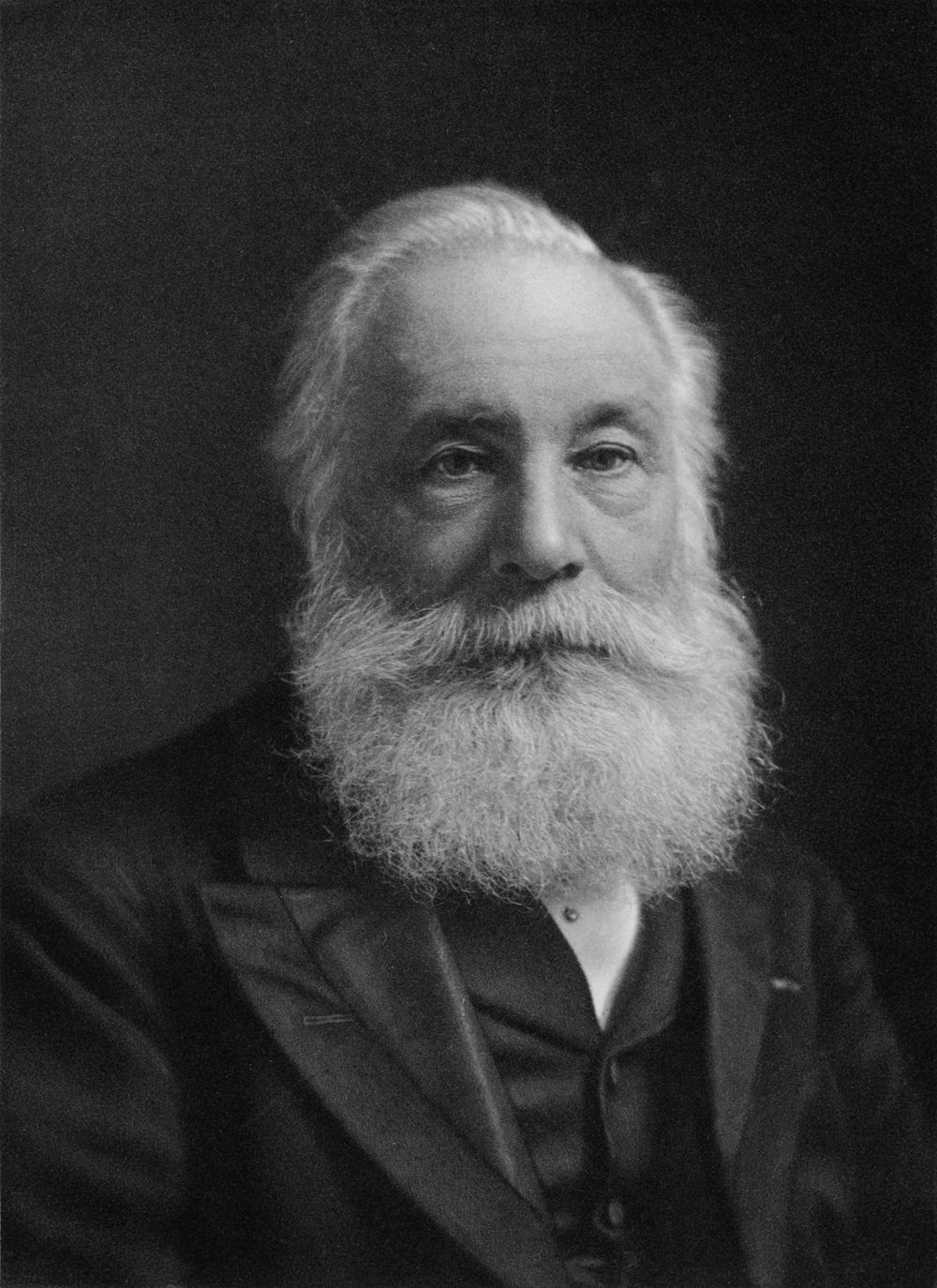
Black-and-white photographic portrait of William Perkin, with a moustache and a dark suit.
William Perkin. Photo: Elliott & Fry, public domain.

Mauve

The color of your clothes came from the waste of gas lighting.

Easter 1856. William Perkin had just turned 18 and was trying to synthesize quinine against malaria, in a makeshift laboratory in the attic of his parents’ house in London.

It went wrong. A black residue was left in the flask. When he washed it out with alcohol, an intense purple appeared that no plant and no mollusk could give. The raw material was coal tar: the leftovers of the gasworks that lit the city.

Read the whole story

He applied for the patent on August 26, 1856, aged 18, and set up a factory with his father and brother. By December 1857 he was already supplying the color to silk dyers.

And he sold it under a borrowed name: “Tyrian purple”, the color of emperors, which was extracted from mollusks and cost more than gold — ten thousand creatures for one gram. The name “mauve” came later, and from France, after the flower.

In August 1859 Punch magazine published “The Mauve Measles”. It described the fashion as an epidemic — it starts with the ribbons and ends up covering the whole person.

What followed: magenta, the aniline blues, synthetic alizarin in 1869. The whole industrial chemistry of color, and later the pharmaceutical industry, came out of it.

He was looking for a medicine and found a color. The color paid for the chemistry that ended up giving us the medicines.

Open this story

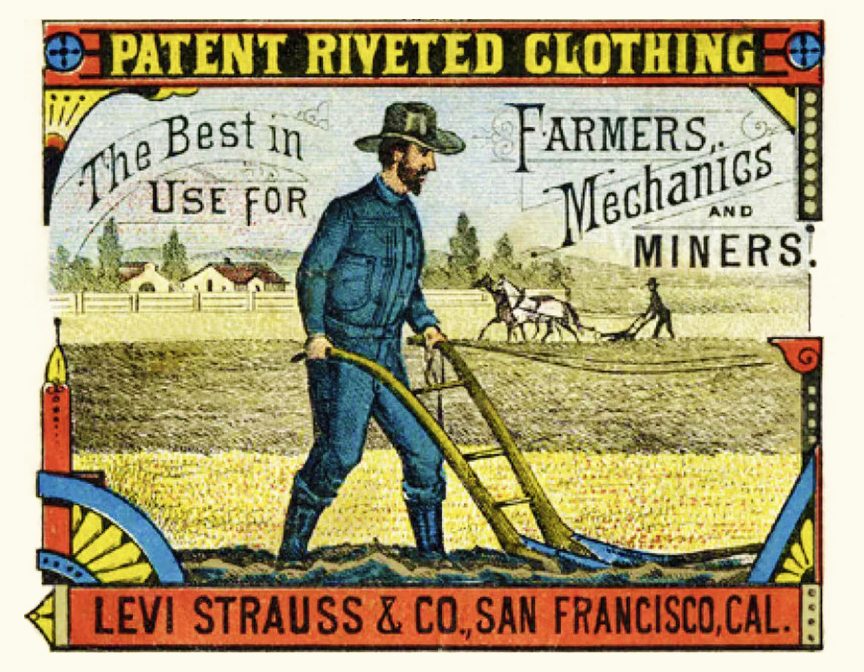
Color illustrated advertisement for Levi Strauss & Co., San Francisco: a man in a hat and blue denim work clothes plows a field; behind him, two horses pull another plow. Above, “Patent Riveted Clothing” and “The Best in Use for Farmers, Mechanics and Miners”.
Levi Strauss & Co. advertisement. Photo: Jim Griffin, CC0.

Jeans

The jeans you’re wearing exist because a tailor didn’t have 68 dollars.

December 1870, Reno. A woman asks Jacob Davis, a tailor, for a pair of trousers that can stand up to her husband, a woodcutter. He reinforces the pockets with copper rivets — the same ones he used on canvas and harnesses.

It becomes a craze among miners and railroad workers. Davis wants to patent it, but registration costs 68 dollars he doesn’t have. So he writes to his fabric supplier, one Levi Strauss, and offers to split it.

Read the whole story

August 9, 1872: they file the application. May 20, 1873: patent US 139,121, “Fastening Pocket-Openings”, is granted. Back then the garment wasn’t called jeans. It was called waist overalls.

In 1890 the patent expired. Anyone could rivet a pair of trousers. What remained was what we now call a brand: the arched stitching on the pocket (1873), the two horses (1886) and, later, the red tab (1936).

Labels weren’t born out of vanity. They were born because the patent ran out and the trousers had to be recognizable from a distance — even by those who couldn’t read.

Open this story

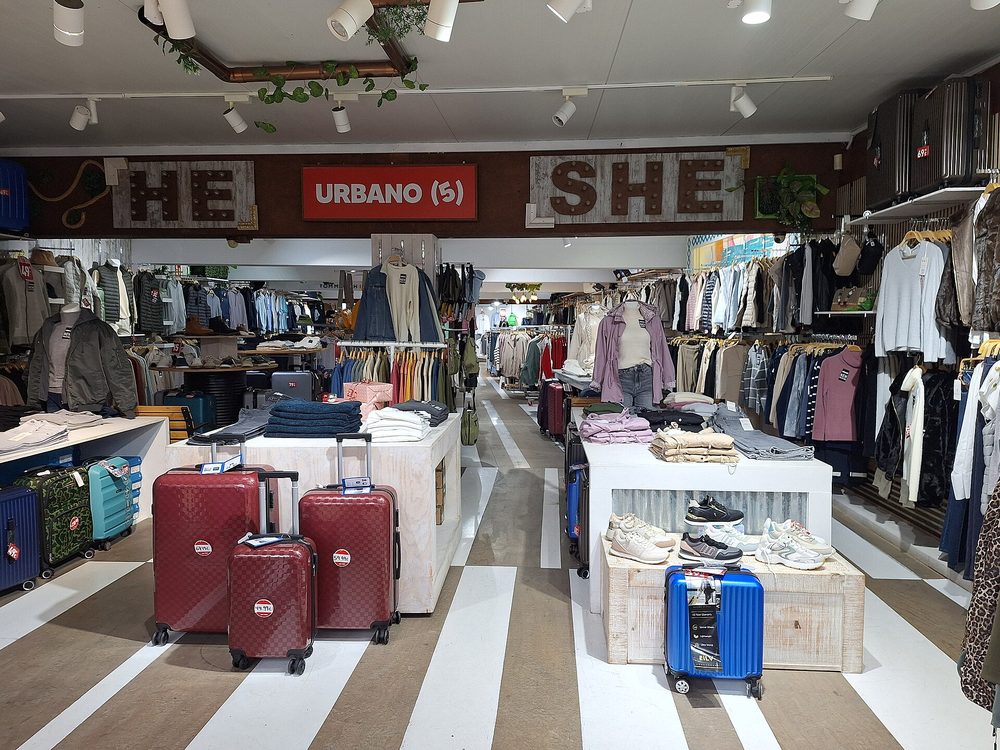
Inside a clothing store: packed rails on both sides, tables of folded clothes and trainers, mannequins and price-tagged suitcases in the foreground, under signs reading “HE”, “URBANO (5)” and “SHE”.
Clothing store in Cala Millor, Majorca. Photo: Steffen Mokosch, CC BY-SA 4.0.

The buyer

The person who decides what’s in your wardrobe isn’t you. Nor the designer.

It’s the store’s buyer. They choose what the store will sell six to nine months in advance.

When you walk into a store, you’re looking at a decision made months earlier, with the season still far away.

Read the whole story

The choice isn’t “I like this coat”. It’s a document: styles, colours, sizes, quantities, wholesale price and delivery dates. All locked in before a single piece exists in the store.

And there’s a ceiling: the buying budget, the open to buy. When it runs out, that’s it — even if the perfect piece turns up later.

If they get it right, they try to restock. It isn’t always possible: it depends on whether the supplier still has fabric and time. If they get it wrong, stock is left over. And unsold stock has only one way out: a discount.

That’s why you sometimes find a sale at an odd time, in the middle of the season. It isn’t the store being generous. It’s a purchase that didn’t go as planned.

That rail isn’t a brand’s taste. It’s one person’s bet, placed months earlier, on a fixed budget.

Open this story

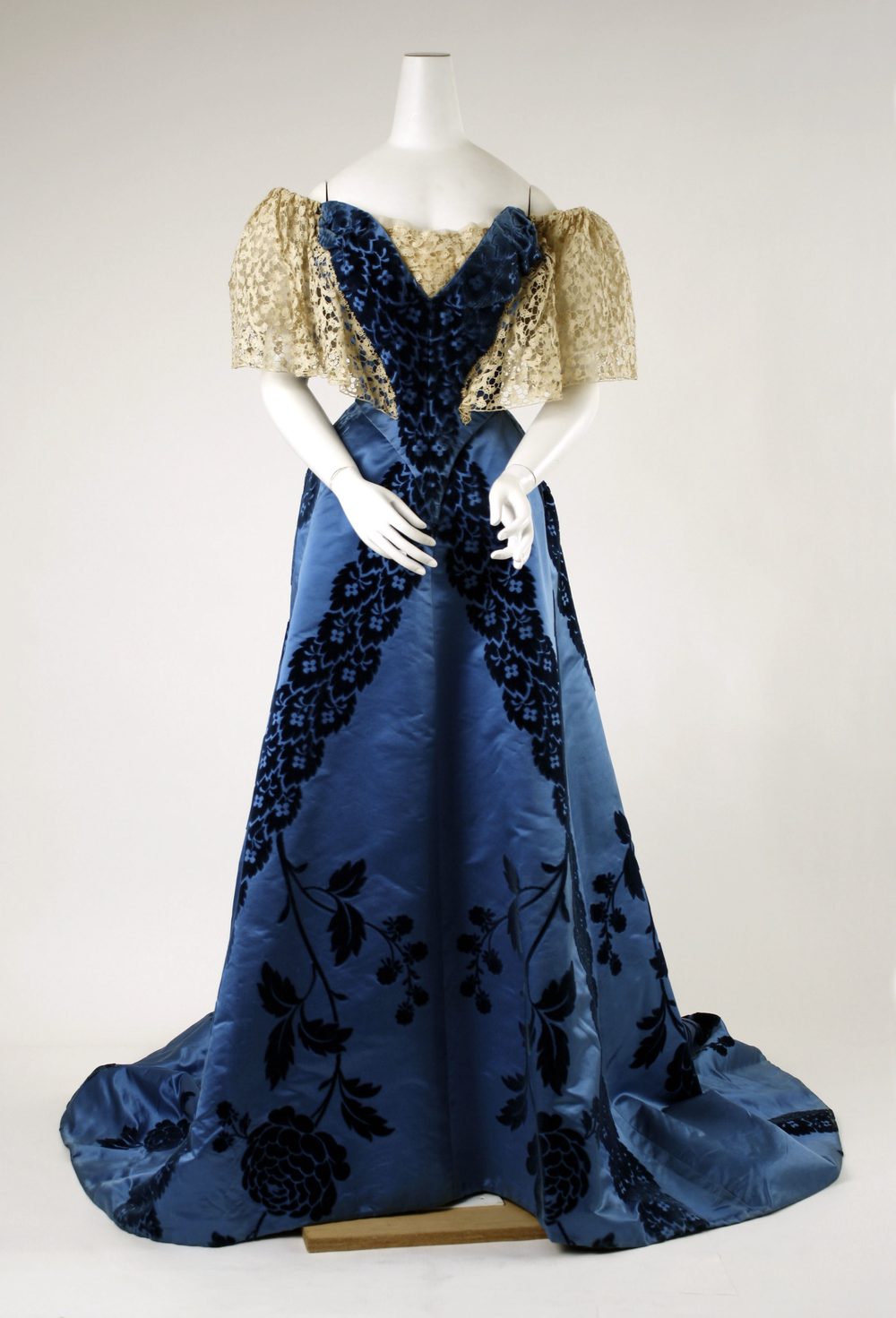
A blue satin evening dress with a train, dark blue floral garlands and short cream lace sleeves, on a white mannequin.
Evening dress, 1898–1900. Photo: The Met, public domain.

Charles Frederick Worth

Before Charles Frederick Worth, the client called the shots on a dress. He turned that around, and fashion still works that way.

He was born in 1825 in Bourne, Lincolnshire. At twenty he moved to Paris and joined Gagelin, a house selling silks and shawls. In 1858 he opened his own, at number 7 rue de la Paix, with the Swede Otto Bobergh.

The client chose the fabric and the dressmaker did as she was told. Worth began designing the models himself, presenting them season by season and letting the client choose among them.

Read the whole story

To show a dress, put a woman in it. Marie Vernet wore the shawls at Gagelin so customers could see them; they married in 1851. Worth turned that into a profession, with models hired by the house. She was the first.

A ball at the Tuileries, 1860: Princess Pauline von Metternich wears Worth. The next day Empress Eugénie wants to meet him. In her memoirs the princess put it plainly: Worth was made, and she was ruined — no more 300-franc dresses.

From the mid-1860s the house stitched a label with its name into the waistband of its dresses. By the late 1880s the label carried his signature, handwritten. Like a painter’s.

A dressmaker became an author. Every name stitched into the clothes you wear comes from that label.

Open this story

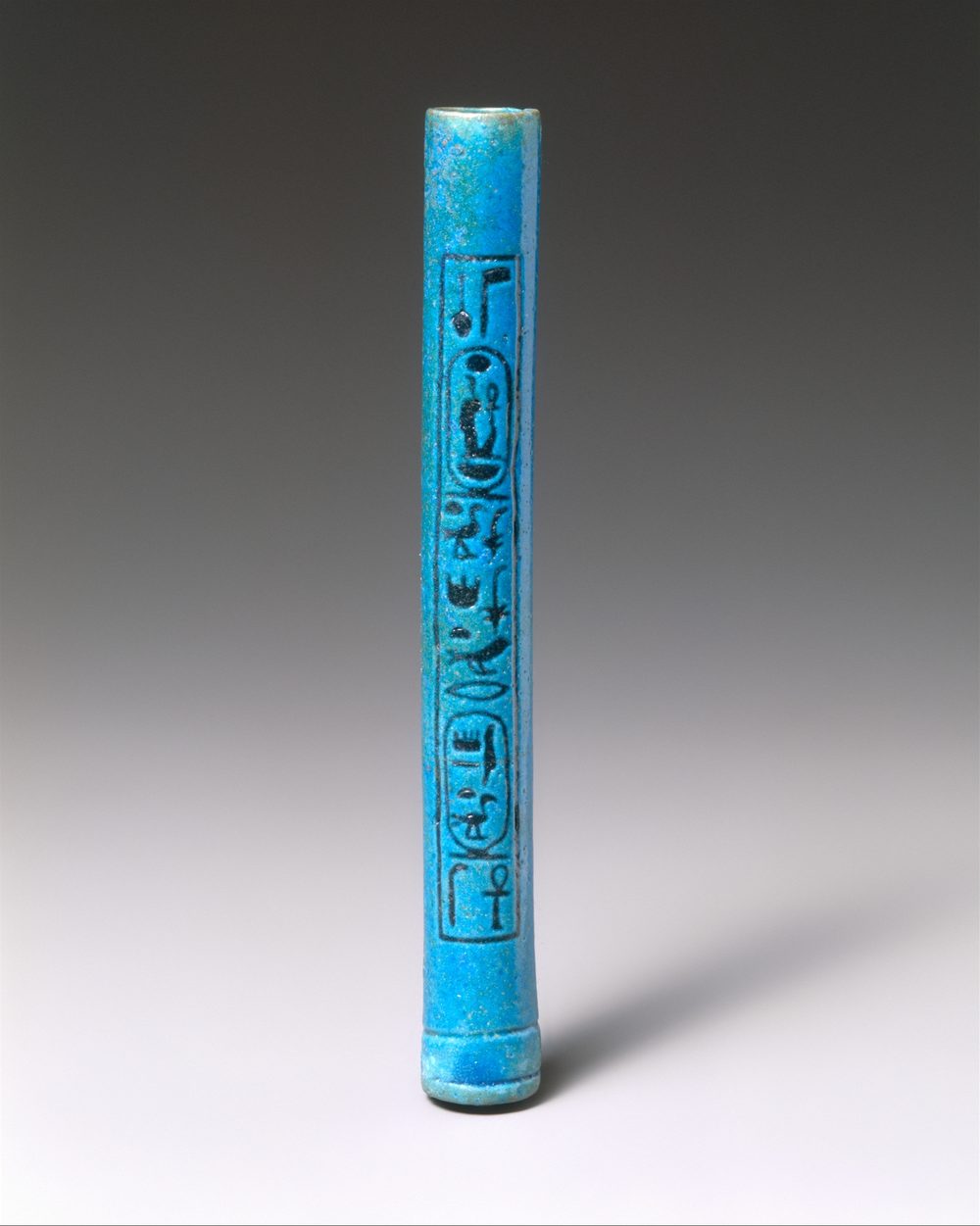
An upright turquoise-blue cylindrical tube with a column of black hieroglyphs, on a grey background.
Kohl tube inscribed for Amenhotep III and Princess Sitamun, ca. 1386–1347 BCE. Photo: The Met, public domain.

Kohl

Egyptian eyeliner was lab chemistry, more than 3,000 years ago.

In ancient Egypt, men and women of every class painted their eyes. Black from galena or green from malachite, ground up and kept in tubes opened with a small stick.

Analysing kohl pots from the Louvre, chemists found laurionite and phosgenite: lead compounds that are extremely rare in nature. They were manufactured from lead oxide, salt and water, filtered and repeated over weeks.

Read the whole story

In 2018, radiocarbon dating of the powder in a Louvre tube bearing the names of Amenhotep III and Queen Tiye confirmed it: the phosgenite was synthetic.

What for? In 2010, researchers from the CNRS and the Louvre found that these compounds, in tiny doses, stimulate the production of nitric oxide in skin cells, one of the body’s defences. Perhaps against infections. Perhaps: it was in a lab, not in people.

And the sun? People keep saying kohl worked as sunglasses. No Egyptian text says so. It’s a reasonable hypothesis, not a fact.

Thousands of years later, the black line hasn’t changed. Only the formula has — and just as well: theirs was made of lead.

Open this story

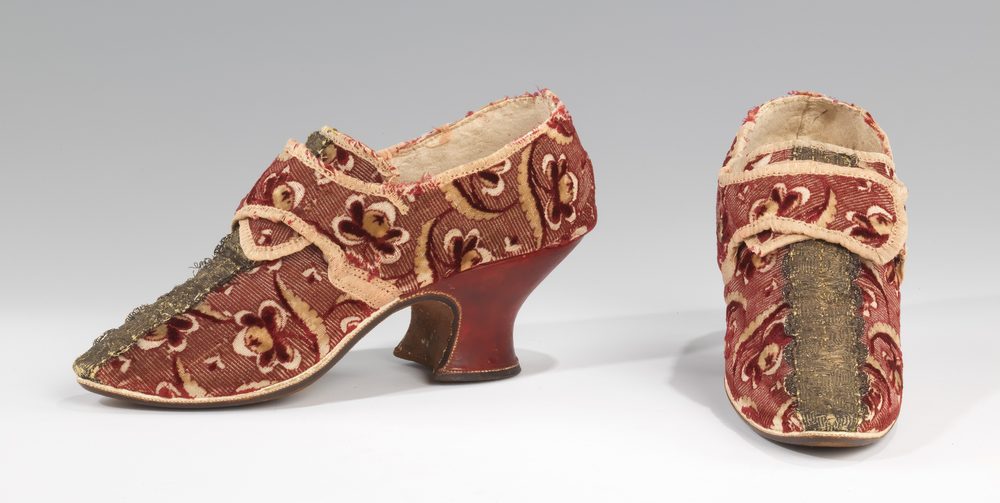
A pair of maroon fabric shoes with cream embroidered flowers, gold braid down the vamp and curved red heels; one seen in profile, the other from the front.
Shoes, 1732–59. The Met, public domain.

Straight shoes

For two centuries, shoes had no left foot and no right.

In the Middle Ages they did. Fourteenth- and fifteenth-century shoes kept at the Museum of London are catalogued as right foot and left foot: medieval shoemakers used mirrored lasts, just like today.

Toward the end of Elizabeth I’s reign, shoes gained heels, and making a mirrored pair with heels was hard work. The fix was an economical one: a single last for both feet. In English, “straights”.

Read the whole story

In 1608 the playwright John Day was already writing about straight shoes, “now of one foot, now of the other”. Whoever wore them shaped the leather by walking.

In 1800 an English regiment ordered its soldiers to swap their boots between feet every other day, so they would wear evenly. It was a military order, not a custom: according to those who study the shoemakers of the period, leather settled to the foot within a few hours.

Around 1800 men’s low shoes had a left and a right again; women’s followed from the 1820s. But many women kept wearing straight pairs until close to 1900.

The shoe with a left and a right is older than the heel. It vanished for two centuries and came back.

Open this story

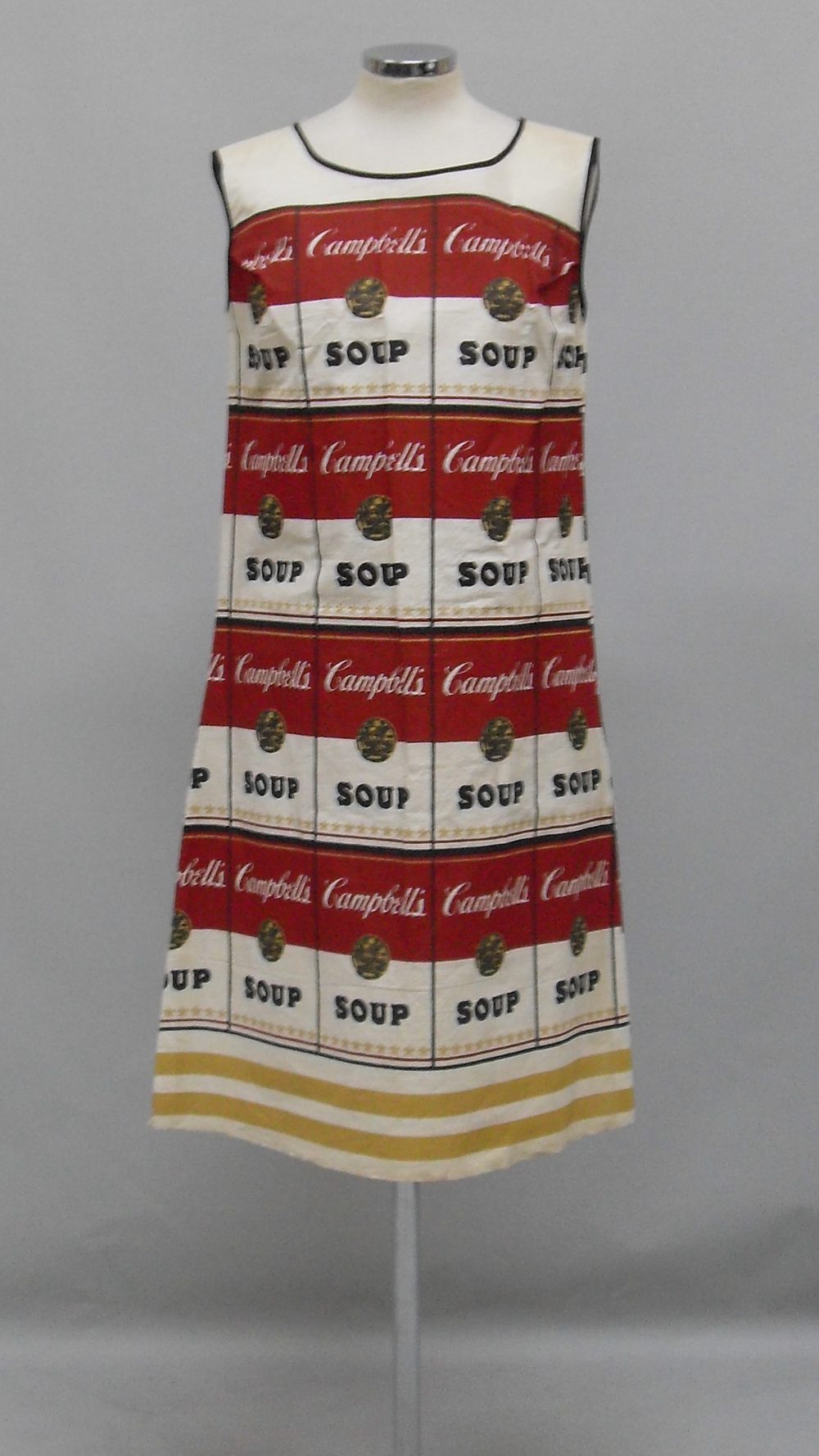
A sleeveless shift dress printed with rows of red-and-white Campbell’s soup cans and two gold stripes at the hem, on a dress form.
Souper Dress. Photo: Peloponnesian Folklore Foundation, CC BY-SA 4.0.

The paper dress

In 1966, a napkin maker became a fashion designer by accident.

Scott Paper was launching a line of coloured paper. To get noticed, it ran the “Paper Caper”: for $1.25 and a proof of purchase, it mailed you a paper dress. Red bandana print or black-and-white op art.

In eight months, half a million dresses, according to Time magazine. Scott ended the promotion by pointing out that it was still a paper company and had no plans to become a fashion designer.

Read the whole story

It wasn’t even just paper: Dura-Weve, 93% cellulose and 7% rayon. It came flame-proofed — until it was washed. The label warned that after water it was dangerously flammable.

It became a craze. Mars, a hosiery maker in Asheville, was selling 80,000 paper dresses a week. A vice-president told Life magazine in 1966 that within five years 75% of the country would be wearing disposable clothes.

And the Souper Dress, the one with the soup cans, isn’t by Warhol. Campbell’s made it itself: one dollar and two soup labels. The Met states in no uncertain terms that it is not his design.

It was over by 1968: they were stiff, they tore, they faded. Wear-once-and-throw-away clothing didn’t catch on. It caught on sixty years later, and not in paper.

Open this story

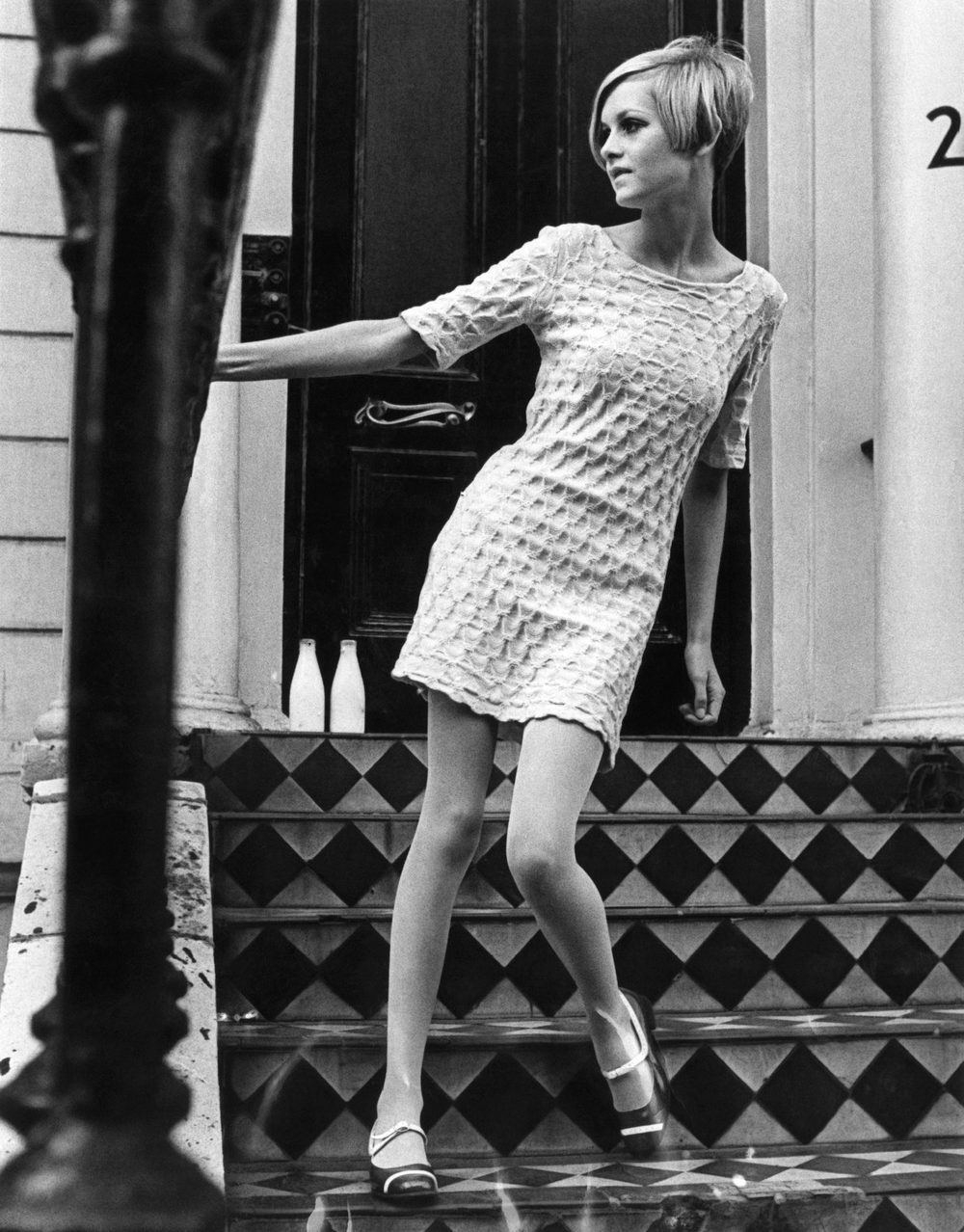
Black-and-white photo of a young woman with short blonde hair and a pale short-sleeved minidress, posing on chequered tiled steps in front of a black door, with two milk bottles by the threshold.
Twiggy in 1967. Photo: KRLA Beat, public domain.

Twiggy

A haircut at 16 and, soon after, the face of the year.

Lesley Hornby was born in 1949 in Neasden, in north London. In 1966 she sat as the model for a short cut at the Leonard of Mayfair salon; upstairs, Daniel Galvin dyed her hair blonde.

Barry Lategan photographed the result, and a portrait ended up hanging in the salon. A Daily Express journalist, one of the salon’s clients, saw it. On 23 February 1966 came the headline: “Twiggy – The Face Of ’66”.

Read the whole story

The nickname came from her thin legs: they called her “Sticks”, and she hated it. It became “Twigs”, then “Twiggy”.

In March 1967 she arrived in New York, aged 17. Newsweek put her on the cover in April, American Vogue several times that year, and Mattel released a doll with her name.

She modelled from 1966 to 1970 and left the profession at twenty. In 1971 she won two Golden Globes for Ken Russell’s The Boy Friend: newcomer of the year and best actress in a comedy or musical. In 2019 she was made a Dame.

Four years were enough to become the face of a decade. Then she chose another life.

Open this story

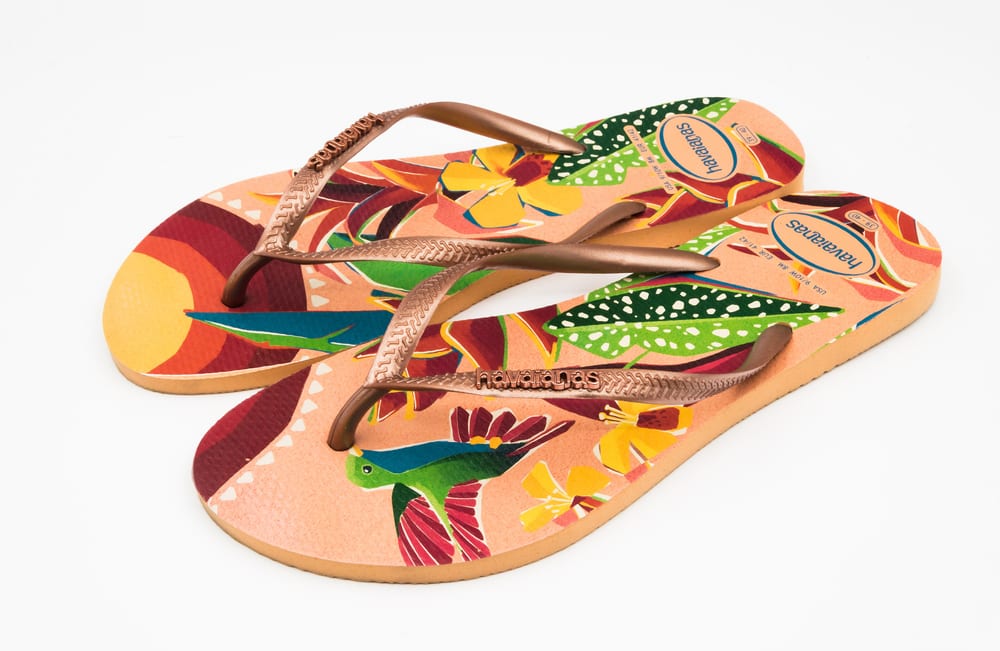
A pair of Havaianas flip-flops with a tropical print and gold straps on a white background.
Havaianas. Photo: Jacek Halicki, CC BY-SA 4.0, Wikimedia Commons.

Havaianas

The most famous flip-flop in the world is a copy, and it was made for people who couldn’t afford shoes.

In 1962 the São Paulo Alpargatas factory copied the zori, the Japanese rice-straw sandal, and made it entirely of rubber. The sole still carries the rice-grain pattern of the straw mat.

The name came from Hawaii, which in the sixties meant the beach of the movies. The price did not: it was the footwear of the builder and the housemaid, sold at the market next to the groceries.

Read the whole story

Copies arrived at once, and in the ads of the seventies and eighties the comedian Chico Anysio repeated what set them apart: they don’t lose their shape, they don’t smell and the straps don’t come off. “Havaianas, as legítimas”: the real ones.

They were so basic that in the eighties the Brazilian government put them on the list of price-controlled goods. And that nearly killed them: by the nineties a cheap flip-flop for the poor was something nobody wanted to be seen in.

1994: sales falling, Alpargatas launches Havaianas Top, single-colour and pricier, and puts them on the feet of actors and models. In 1998, for the World Cup in France, a strap with the Brazilian flag. The worker’s flip-flop became Brazil on your feet.

By 2000 they had stores in luxury malls in the United States and Europe. Same rubber, same rice grain on the sole: what changed was who wanted to be seen wearing them.

Open this story

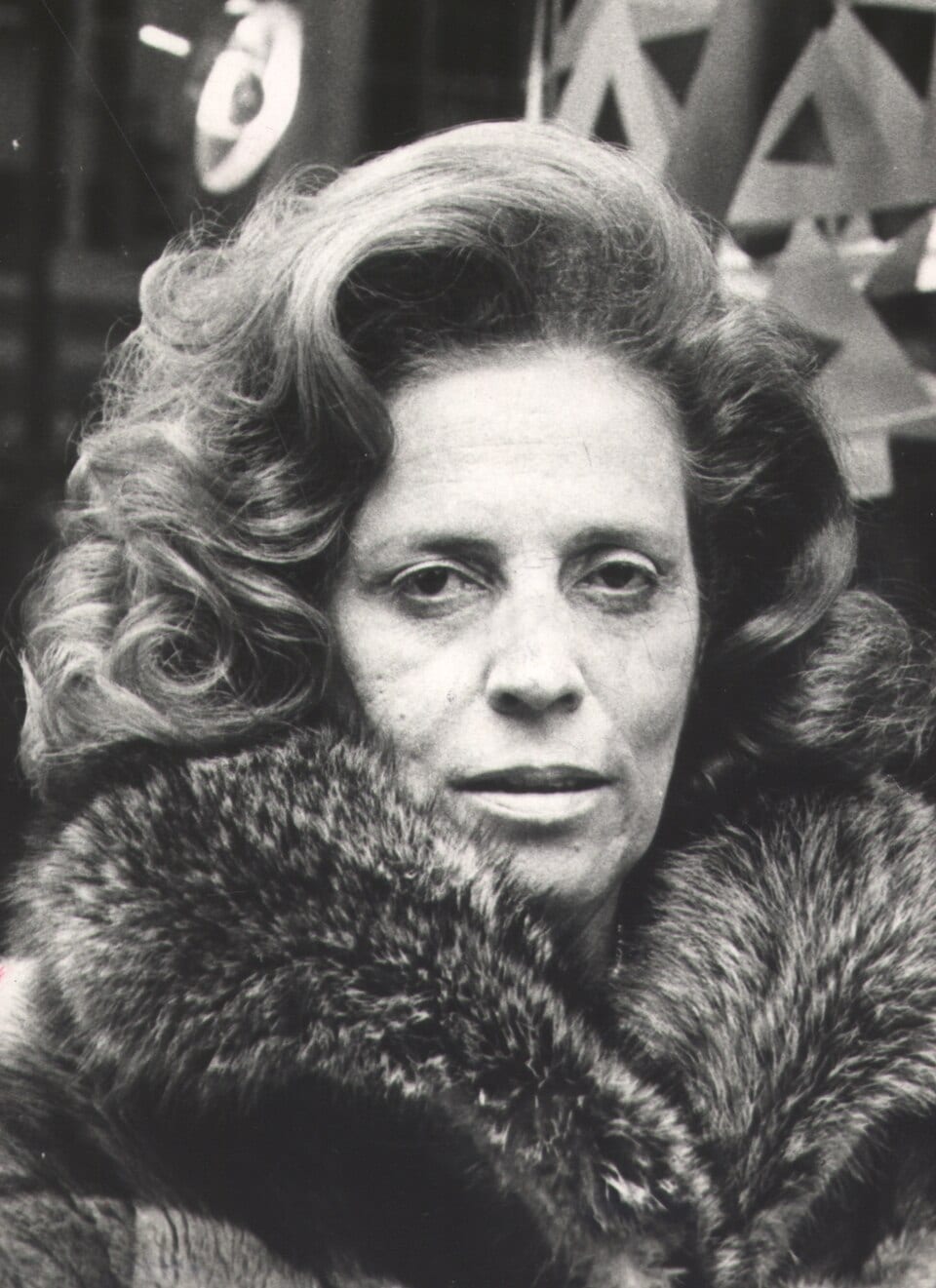
Black-and-white portrait of Zuzu Angel, with wavy blonde hair and a fur coat, looking at the camera.
Zuzu Angel in New York, 1972. Arquivo Nacional, Correio da Manhã collection, public domain.

Zuzu Angel

She turned a fashion show into an accusation, and the dictatorship never forgave her.

Zuleika Angel Jones, Zuzu, was born in Curvelo, Minas Gerais, in 1921. Her dresses, with Brazilian flowers, birds and embroidery, sold in Rio and New York; Joan Crawford and Kim Novak wore them.

In May 1971 her son Stuart, a member of the MR-8 resistance against the military dictatorship, was arrested in Rio. He was tortured to death at the Galeão air base. The body was never returned.

Read the whole story

On 13 September 1971, at the residence of Brazil’s consul general in New York, Zuzu showed her collection. On the dresses the birds were in cages, the angels were tied up, and among the flowers came tanks, cannons and toy soldiers. It was the first protest fashion show in Brazilian fashion, and the foreign press got the message.

For five years she kept asking where her son was: letters to US senators, to Henry Kissinger, to anyone who could lean on the regime. She wrote to friends that if anything happened to her, it would not be an accident.

On 14 April 1976 her car left the road coming out of the Dois Irmãos tunnel in Rio. An accident, the police said. In 2014 the National Truth Commission concluded it was the state: witnesses saw another car push her off the road.

The tunnel is now called Túnel Zuzu Angel. Her dresses are kept by the institute that bears her name, with the angel, the caged bird and the cannon embroidered on pale cloth, just as she showed them in New York.

Open this story

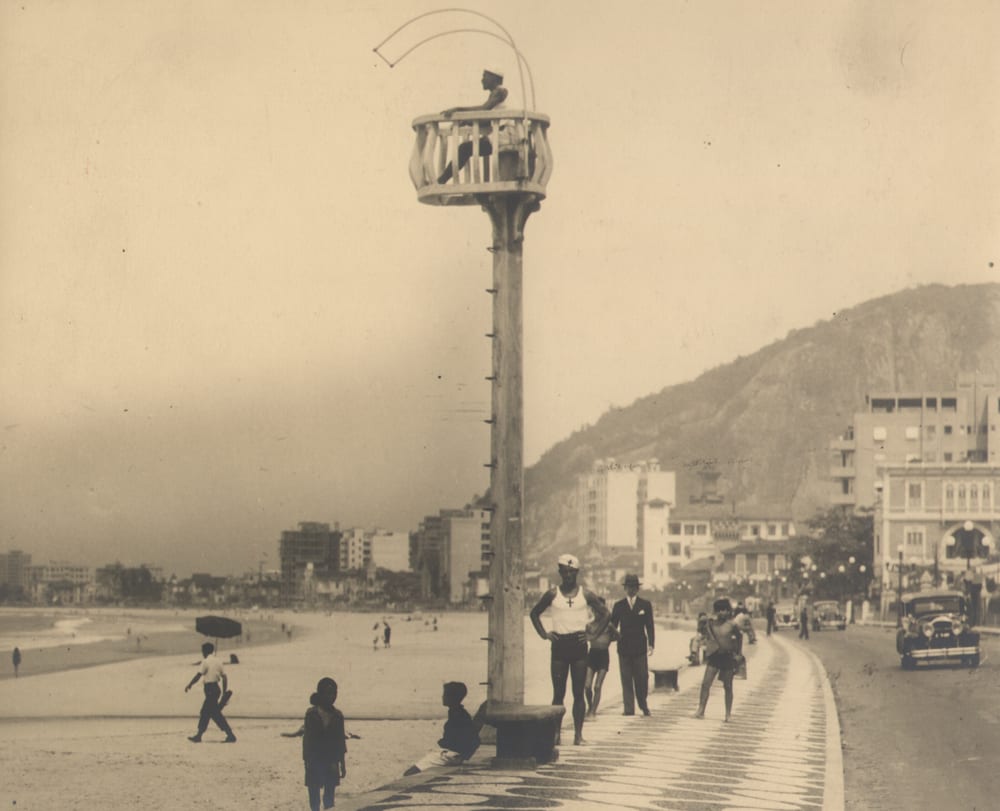
Old sepia photograph of Copacabana beach with a wooden lifeguard tower, bathers and the wave-pattern pavement in the foreground.
Copacabana beach, Rio de Janeiro, 1930s. Arquivo Nacional, Correio da Manhã collection, public domain.

The bikini

It was born in Paris and banned across half of Europe. Brazil made it its own, then cut it smaller.

On 5 July 1946, at the Molitor pool in Paris, Louis Réard unveiled a two-piece so small that no model would wear it; a cabaret dancer, Micheline Bernardini, did. He named it after the atoll where the United States had just tested an atomic bomb: Bikini.

Spain, Italy and Portugal banned it from their beaches, and the Vatican called it a sin. In Brazil the story goes that the first one was seen on a Rio beach in 1948, and that people stopped to stare. Nobody banned it there.

Read the whole story

In 1971 the actress Leila Diniz let herself be photographed in Ipanema, pregnant and in a bikini. The picture went around the country: a woman with her belly out, in the middle of a dictatorship, asking nobody’s permission.

In 1972 David Azulay sewed a bikini for his girlfriend and founded Blue Man, in Rio. Two years later the model Rose Di Primo, the face of the label, walked onto Ipanema beach in something even smaller: the tanga, the thong bikini. Some say she invented it; what is certain is that it stayed in Rio.

In the eighties the women of Rio rolled up the sides of their bikinis to get less fabric and more skin; from that came the “asa-delta” and then the “fio dental”, the dental-floss bikini. Brazil was no longer copying Paris: it was exporting.

In 2026 a bill proposed declaring the tie-side bikini intangible cultural heritage of Rio de Janeiro. Eighty years after Molitor, the piece a French engineer invented wants to be, by law, a Rio thing.

Open this story

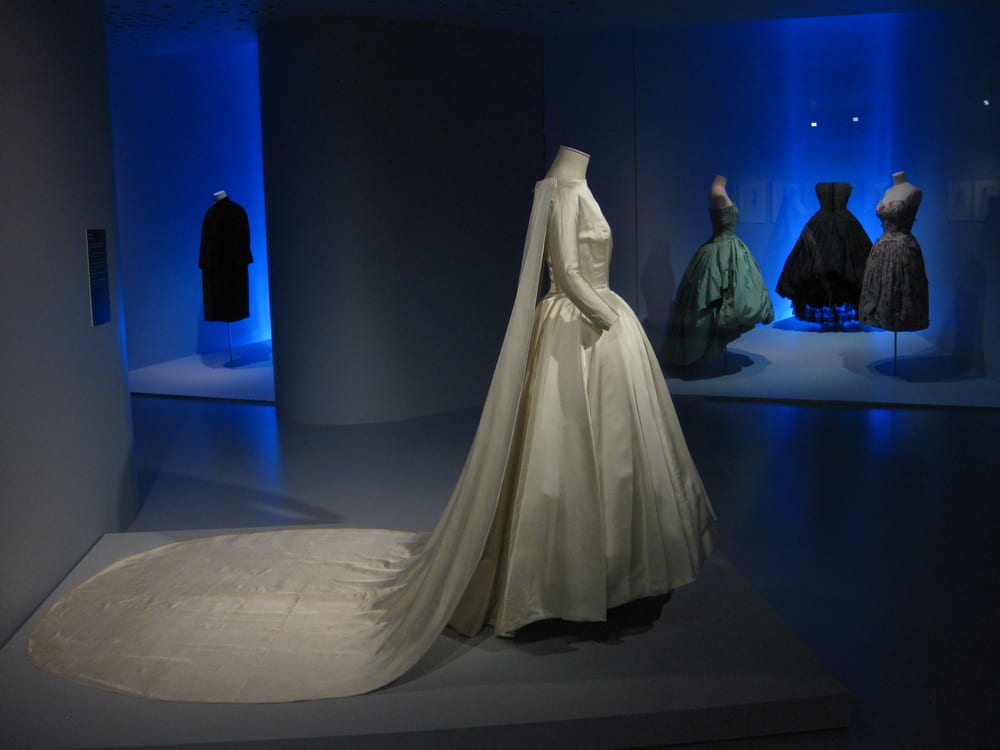
A white Balenciaga wedding dress with a long train in a museum room lit in blue, with three evening gowns behind.
Cristóbal Balenciaga Museum, Getaria. Photo: Kippelboy, CC BY 3.0, Wikimedia Commons.

Cristóbal Balenciaga

The son of a Getaria fisherman, and Dior called him “the master of us all”.

He was born in Getaria, in the Basque Country, in 1895. His father was a fisherman and his mother a seamstress who sewed for the Marchioness of Casa Torres, who summered in the village. At eleven the boy made her a dress, and she wore it.

He opened in San Sebastián in 1917 and, when the Civil War broke out, left for Paris. In 1937 he opened his house on Avenue George V, and Paris, which already had Chanel and would soon have Dior, discovered a Spaniard who did something strange: he kept quiet and cut.

Read the whole story

Chanel said he was the only real couturier, because he was the only one who could design a dress, cut it, assemble it and sew it with his own hands. The others, she said, drew.

In 1957, when everyone was copying the wasp waist of Dior’s New Look, he showed the sack dress: straight, no waist, the body inside it rather than squeezed by it. The Daily Mirror ran a headline saying it was hard to be sexy in a sack. Ten years later every woman had one.

In 1960 he dressed Fabiola de Mora for her wedding to the King of the Belgians. He gave no interviews, never took a bow at the end of a show, and presented his collections to the press a month after the other houses, so that nobody could copy them.

In 1968 he closed the house: he would not make ready-to-wear, clothes in series, and preferred to stop. He died in Xàbia in 1972. Since 2011 Getaria has had a museum devoted to him, next to the palace of the marchioness his mother sewed for.

Open this story

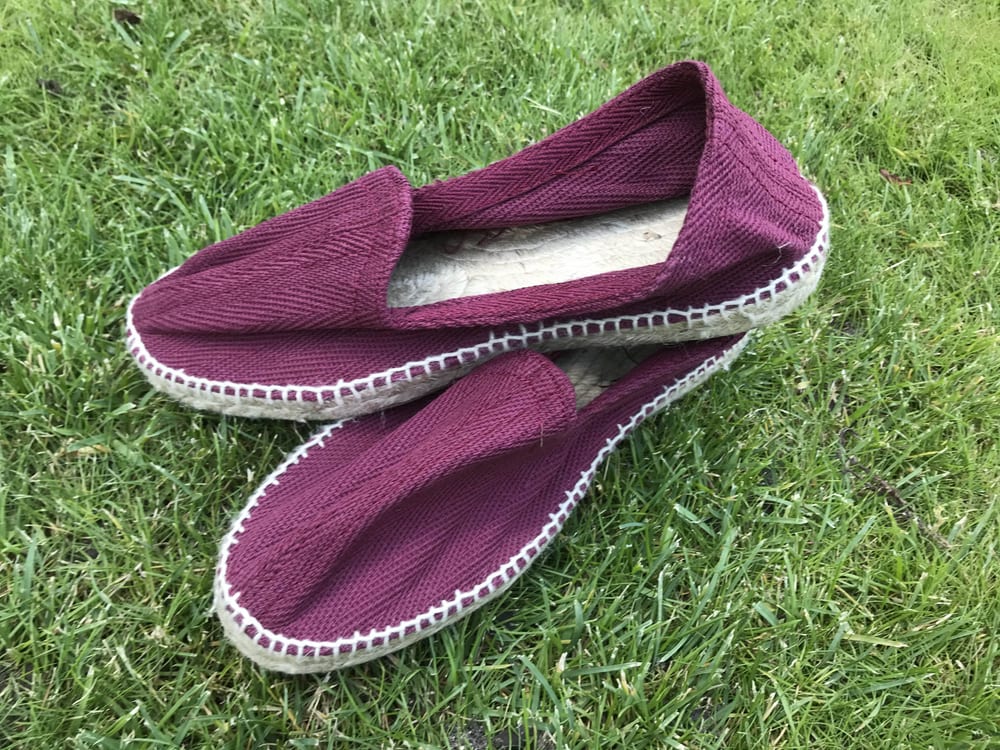
A pair of burgundy canvas espadrilles with braided jute soles, on grass.
Espadrilles. Photo: ElArtesano1891, CC0, Wikimedia Commons.

The espadrille

A peasant’s shoe for six hundred years, until Yves Saint Laurent asked for one with a heel.

A sole of braided and stitched esparto or jute, with cloth on top. They have been made in the Pyrenees since the 14th century; in Catalan, espardenya. It was what you wore when you couldn’t spend a day’s wage on leather: peasants, fishermen, workers and soldiers.

In 1927 Lluís Castañer and his cousin Tomàs Serra opened a workshop in Banyoles, near Girona. The family had been making espadrilles since 1776; what was new was making them by machine, for the whole country.

Read the whole story

The Civil War made them the footwear of soldiers on both sides, and then of the post-war years: cheap, for summer, for the poor. By the sixties hardly anyone wanted them.

In the early seventies, at a trade fair in Paris, Yves Saint Laurent walked up to the Castañer stand with an order: an espadrille with a wedge heel, for the runway. The esparto wedge did not exist; they invented it for him. It went down the runway and from there to half the world.

Since then the espadrille has lived two lives: the market-stall one, at five euros, still the same as in 1927, and the designer wedge, sold in Paris and Tokyo. Both have the same braided sole.

Chanel, Louboutin, Hermès: almost every house now has an espadrille in its summer catalogue. And many are still stitched in the same villages of Girona and La Rioja as a century ago.

Open this story

Glass façade of a Zara store on a Madrid street corner, lit at dusk, with people on the pavement.
Zara store on Calle Princesa, Madrid. Photo: Luis García (Zaqarbal), CC BY-SA 3.0 ES, Wikimedia Commons.

Zara

It was going to be called Zorba, and the owner has never given an interview.

On 9 May 1975 Amancio Ortega opened a shop at number 64, Calle Juan Flórez, in A Coruña. He wanted to call it Zorba, after the film, but the name was taken. With the same letters came Zara.

Ortega had started as a teenager running errands for a shirt shop in the city. In 1963 he set up a workshop with Rosalía Mera, GOA, and sold quilted dressing gowns to shops: the gown customers saw in the window and could not afford, made cheaper.

Read the whole story

The 1975 shop was the same idea without the middlemen: his factory, his shop, his price. What he saw in other people’s windows, Ortega made and sold himself.

The real invention came later. The industry designed in winter what would sell in summer; Zara looked at what was selling this week and had it in store two weeks later, sewn close to home, in Arteixo, in short runs. If a garment did not sell, it was not repeated; if it did, it came back with changes. Stores get new stock twice a week.

Inditex was born in 1985, the first store abroad opened in Porto in 1988, and in 2001 the company went public. Ortega, the son of a railway worker, became the richest man in Spain. He still gives no interviews.

The Juan Flórez shop closed on 30 January 2026, fifty years on, to become a supermarket. The chain now has thousands of stores, but the method is that of the first one: look at what people are wearing and have it fast.

Open this story

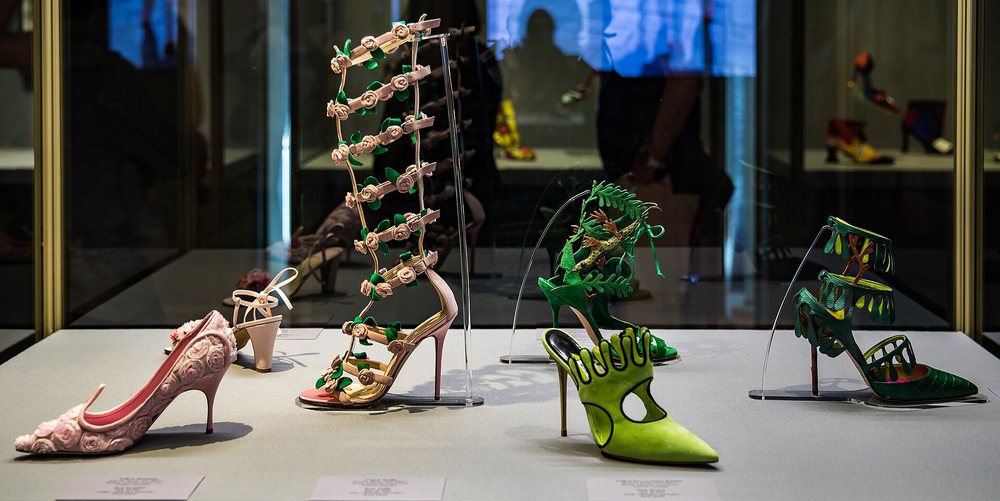
Museum display case with five high-heeled shoes: a pink pump covered in roses, a tall strappy sandal with flowers and three green cut-out designs.
Manolo Blahnik shoes at the Hermitage, Saint Petersburg, 2017. Photo: Ninara, CC BY 2.0, Wikimedia Commons.

Manolo Blahnik

As a boy he made shoes for lizards out of the foil from sweet wrappers.

He was born in 1942 in Santa Cruz de La Palma, to a Czech father and a Spanish mother, and grew up on the family’s banana plantation. The story about the lizards is his own.

He studied in Geneva, passed through Paris and ended up in London. He wanted to be a set designer. In New York, Paloma Picasso introduced him to Diana Vreeland, the legendary Vogue editor. She looked at his sketches for “A Midsummer Night’s Dream” and, as the house tells it, said: “Focus on extremities, young man! Do shoes!”

Read the whole story

He took her advice without knowing how to make them. For an Ossie Clark show in London, in 1971 according to the brand itself, he forgot to put steel pins in the heels, which bent on the catwalk. He learned the craft afterwards, visiting factories in Italy.

He took over a shop on Old Church Street, in Chelsea, which is still his home. In 1974 he appeared on the cover of British Vogue with Anjelica Huston, photographed by David Bailey. In 1979 he opened in New York.

In the late nineties, the series “Sex and the City” tied his name to Carrie Bradshaw’s. The Hangisi, the satin pump with the buckle, was created for the spring-summer 2008 collection.

Every shoe starts as a drawing of his, by hand, and the house keeps an archive of more than 30,000 designs. They are made near Milan. In 2012 he received Spain’s National Fashion Design Award, and in 2017 the National Museum of Decorative Arts in Madrid gave him the exhibition “The Art of Shoes”. In 2022, after a twenty-two-year lawsuit, China’s Supreme People’s Court gave him back the right to use his own name there.

Open this story

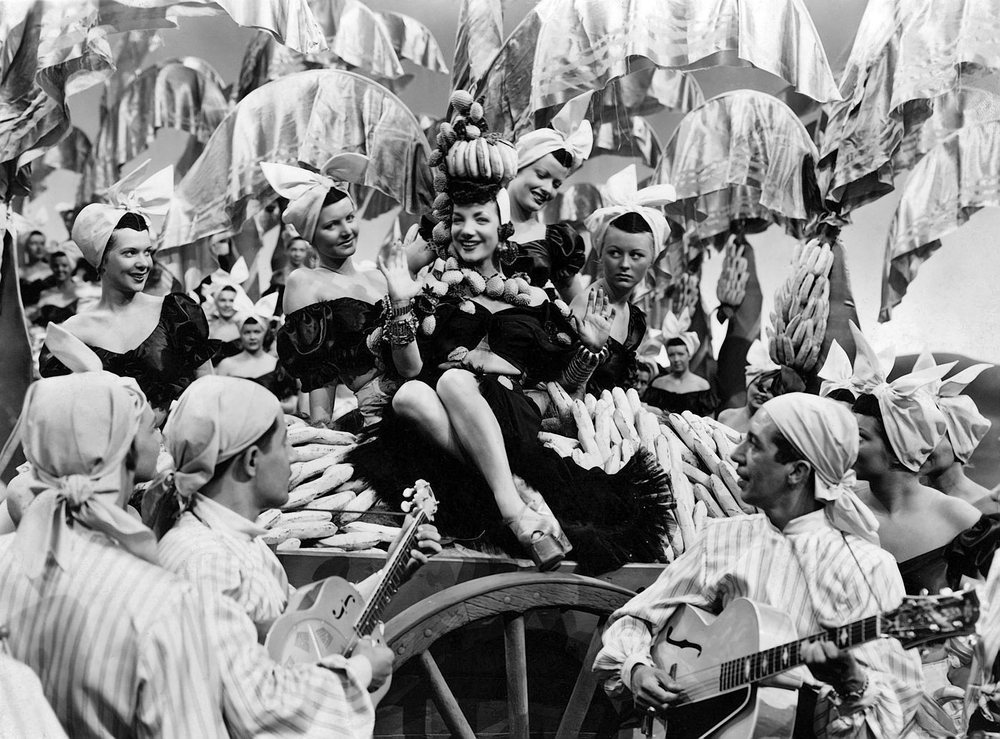
Carmen Miranda sitting on a cart loaded with bananas, wearing a fruit headdress and platform shoes, surrounded by chorus girls in turbans; two musicians play guitar.
Carmen Miranda in “The Gang’s All Here”, 1943. 20th Century Fox, public domain, Wikimedia Commons.

Carmen Miranda

Before she sang she made hats, and ended up wearing a fruit bowl on her head.

She was born in 1909 in Marco de Canaveses, Portugal, and arrived in Rio de Janeiro before her first birthday. As a young woman she worked in a hat shop, where she learned the trade. She stood just over five feet tall, and in Brazil they called her “A Pequena Notável”, the remarkable little one.

In the film “Banana da Terra”, released in 1939, she appeared for the first time dressed as a baiana to sing “O que é que a baiana tem?”, by Dorival Caymmi. The costume came from the women who sold food in Rio’s Praça Onze. The turban she made herself: according to the Museu Carmen Miranda, she designed most of the ones she wore.

Read the whole story

That same year, the impresario Lee Shubert saw her perform at the Cassino da Urca and signed her for Broadway. In May 1939 she sailed for New York and in June she opened in “The Streets of Paris”. According to the museum, actresses and many other women copied her turbans, especially during the war.

To gain height she wore platforms, which the museum links to Portuguese clogs. The Ferragamo Museum in Florence keeps a 1939 sandal created for her.

In July 1940 she returned to Rio and was received coldly. One newspaper wrote that she had spoiled Brazilian music by filling it with American things. She answered with a song: “Disseram que voltei americanizada”, they said I came back Americanised.

In 1943 she shot “The Gang’s All Here”, with the number “The Lady in the Tutti Frutti Hat”, among chorus girls and giant bananas. In the mid-forties she was the highest-paid woman in the United States, earning more than 200,000 dollars a year. She died on 5 August 1955 in Beverly Hills, aged 46. The museum that bears her name, in Rio’s Aterro do Flamengo, holds more than 3,000 pieces.

Open this story

Entrance to the Galeria Melissa: walls covered in a jungle mural in shades of green, vertical gardens of ferns and a narrow display case with sandals.
Galeria Melissa, São Paulo, 2010. Photo: Yusuke Kawasaki, CC BY 2.0, Wikimedia Commons.

Melissa

A factory that made covers for wine demijohns ended up making shoes with Zaha Hadid.

In 1971, the brothers Alexandre and Pedro Grendene opened a factory in Farroupilha, in Rio Grande do Sul, making plastic mesh for the wine demijohns of the Serra Gaúcha, which until then had been wrapped in wicker. Five years later they were making soles and heels.

In 1979, Pedro Grendene noticed the strap sandals worn by fishermen on the French Riviera and made them in plastic. He called it the Melissa Aranha. According to the brand, it appeared on Sônia Braga’s feet in “Dancin’ Days”, the TV Globo telenovela that ended in January of that year.

Read the whole story

In 1983 it began commissioning designs from runway designers. The first were Jean-Paul Gaultier, Thierry Mugler, Jacqueline Jacobson and Elisabeth de Seneville. In 1984 came the Melissinha, for girls.

In 1996 Grendene repositioned the brand, with Claudia Schiffer as its face. In 2002 it showed for the first time at São Paulo Fashion Week.

Since then it has worked with the Campana brothers (2004), with Vivienne Westwood and Zaha Hadid (2008) and with Karl Lagerfeld (2013). In 2005 it opened the Galeria Melissa on Rua Oscar Freire in São Paulo; New York (2012) and London (2014) followed. In 2010, two of its sandals entered the collection of the Design Museum in London.

The material has a name of its own, Melflex, a PVC with an exclusive formula and a tutti-frutti scent. The company says it is one hundred percent recyclable and collects used pairs in its shops.

Open this story

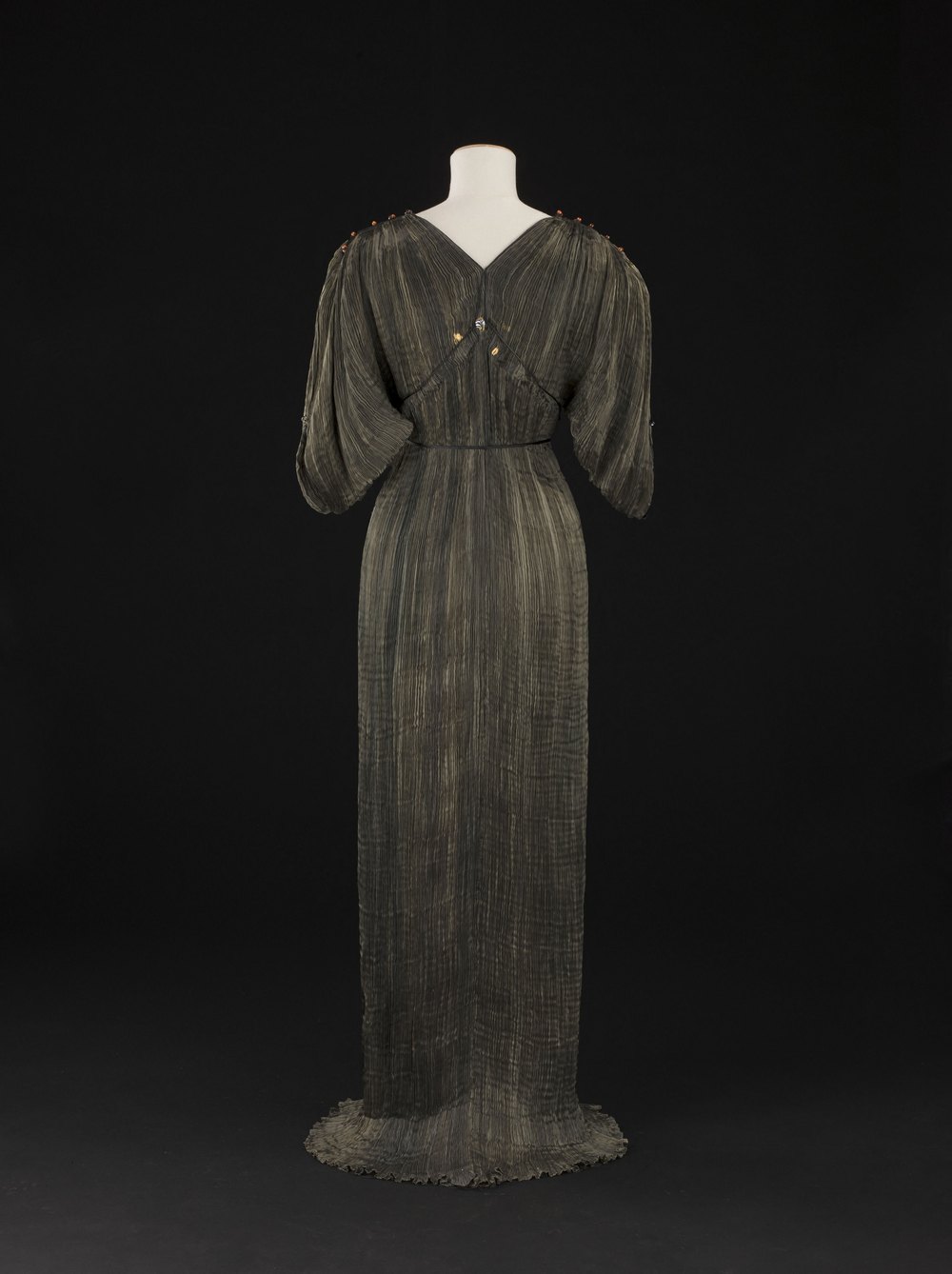
A Delphos gown of dark bronze pleated silk on a mannequin, with wide sleeves and small glass beads at the shoulders, against a black background.
Delphos gown, c. 1913. Palais Galliera, musée de la Mode de la Ville de Paris, CC0, Wikimedia Commons.

The Delphos gown

The patent was in Fortuny’s name, and he wrote by hand that she was the inventor.

Mariano Fortuny was born in Granada in 1871 and ended up in Venice. Between 1907 and 1909 his workshop produced a gown of silk pleated so finely that it fell like a Greek column. They called it the Delphos, after the Charioteer of Delphi.

The pleating was patented in Paris in 1909, in his name. But on a copy of the patent Fortuny left a note in his own hand: it belonged to Henriette, his partner, “who is the inventor”. He had registered it in his name because of the urgency.

Read the whole story

A century later, the Victoria and Albert Museum in London changed its records: Henriette Negrin was largely, if not wholly, responsible for the gown.

It is made of several narrow panels sewn by hand into a tube. It carries Venetian glass beads threaded on a silk cord: they decorate it and give it weight.

It was not hung up. It was rolled lengthwise, twisted into a ball and kept in a small box, so that it would not lose its pleats. Several museums hold the gown with its original box.

Sarah Bernhardt and Isadora Duncan were among the first to wear it, and Proust dressed the Albertine of his novel in Fortuny. One secret remains: exactly how the pleats were made was never documented.

Open this story

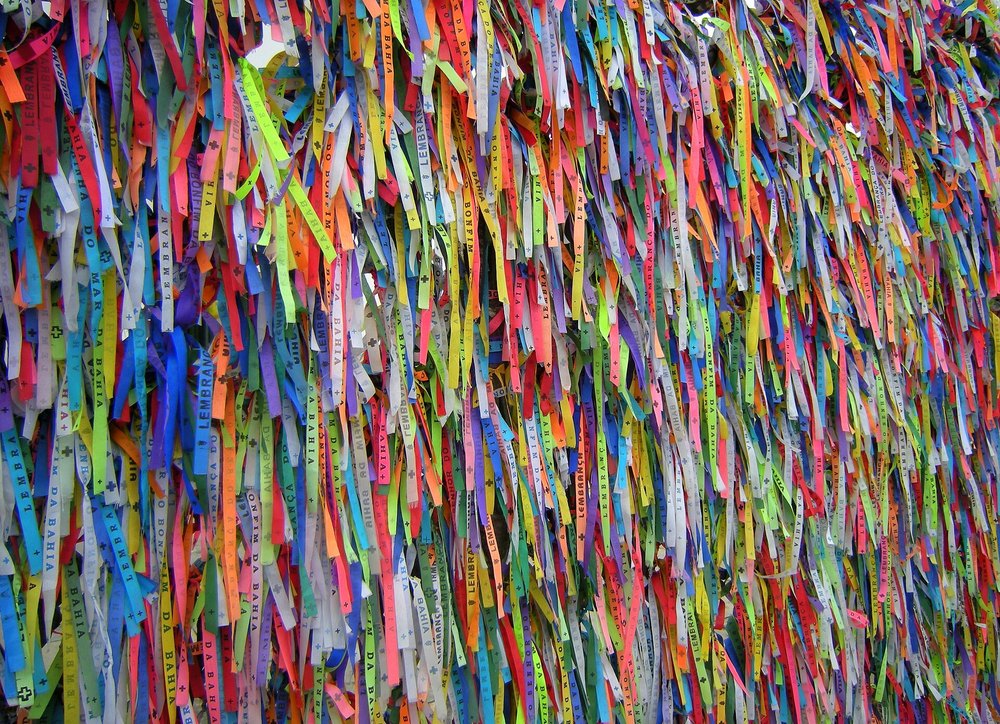
Dozens of coloured Senhor do Bonfim ribbons tied side by side, filling the whole picture.
Bonfim ribbons, Salvador da Bahia. Photo: Leandro Neumann Ciuffo, CC BY 2.0, Wikimedia Commons.

The Bonfim ribbon

The three-wish bracelet did not begin as a bracelet: it was as long as the arm of a Christ and was worn round the neck.

In Salvador da Bahia they called it a “medida”, a measure, because it measured 47 centimetres: the length of the right arm of the statue of Senhor do Bonfim. It was a wide, embroidered, expensive ribbon, worn round the neck, over the shoulders or on the hat.

The official version says it was created in 1809 by Manoel Antônio da Silva Serva, treasurer of the brotherhood, and sold to pay for the church. But one of the brotherhood’s own books already records the measures in 1792. What Serva did, the man who set up Bahia’s first printing press in 1811, was make them and sell them.

Read the whole story

Nor was it a Bahian idea. According to the researcher Nelson Cadena, “saints’ measures” came from Portugal, and Bahia had them for other saints too.

That ribbon disappeared in the twentieth century, and nobody can say when it moved from the neck to the wrist. A 1959 photograph by Pierre Verger already shows a seller of Bonfim ribbons.

Today’s is something else: polyester, a centimetre wide, factory-made and mostly outside Bahia. Brazil’s heritage institute says it plainly: the traditional measure was lost to industrialisation.

And the three knots, one wish per knot, until it falls off by itself? That is how it is worn today, but no old document records it. Nor that each colour belongs to an orixá: according to the rector of the basilica, the original measure was white.

Open this story

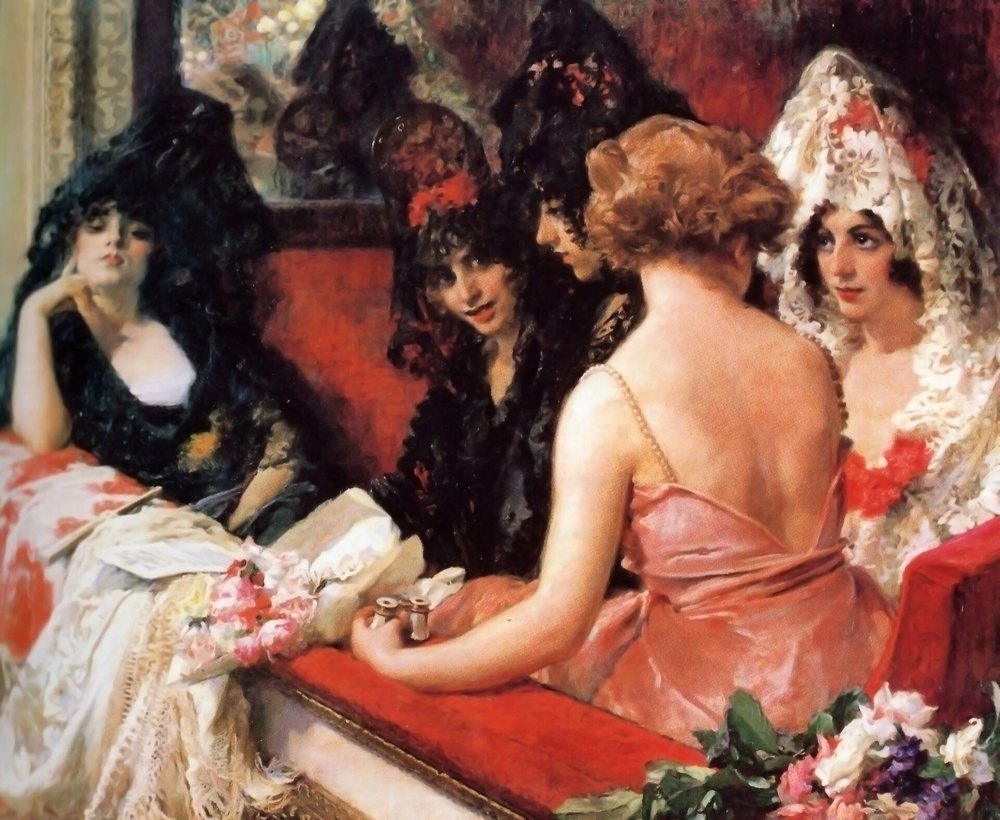
Oil painting: several women in mantillas in a theatre box; over the rail hangs a white shawl embroidered with red flowers, with a fringe.
Francisco Pradilla y Ortiz, “Manolas en el palco”. Public domain, Wikimedia Commons.

The Manila shawl

Spain’s most Spanish shawl is not from Manila, and in China, where it was embroidered, nobody wore it.

It was embroidered in southern China, in the workshops of Canton and Macao. Manila gave it its name because that was the port where the goods changed ships. And the square shawl does not exist in traditional Chinese dress: it was made only to be sold abroad.

The name comes from the route. The Manila Galleon linked the Philippines with Acapulco from 1565 to 1815; from there the cargo crossed Mexico overland to Veracruz and went on to Spain. But the dated shawls kept in museums are from the nineteenth century, and the Victoria and Albert Museum in London places their boom from 1821 onwards, when the galleon was already gone.

Read the whole story

The designs changed with the customer. The first carried Chinese scenes: figures, pagodas, dragons and birds. Later the large flowers of Western taste won out: roses, carnations and lilies.

And they were huge. One in the National Museum of Decorative Arts in Madrid measures 194 by 202 centimetres, with a 42-centimetre fringe. In Britain they were also used to cover pianos and tables.

Galdós gave it a passage in “Fortunata y Jacinta”, in 1887: he attributes the embroidery to a Chinese artist, Ayún, and says it was worn by grand ladies and Gitanas alike.

In 1894 “La verbena de la Paloma” opened in Madrid, with its habanera: “¿Dónde vas con mantón de Manila?”, where are you going in a Manila shawl? By then it had passed from high society to popular festivals, and there it stayed.

Open this story

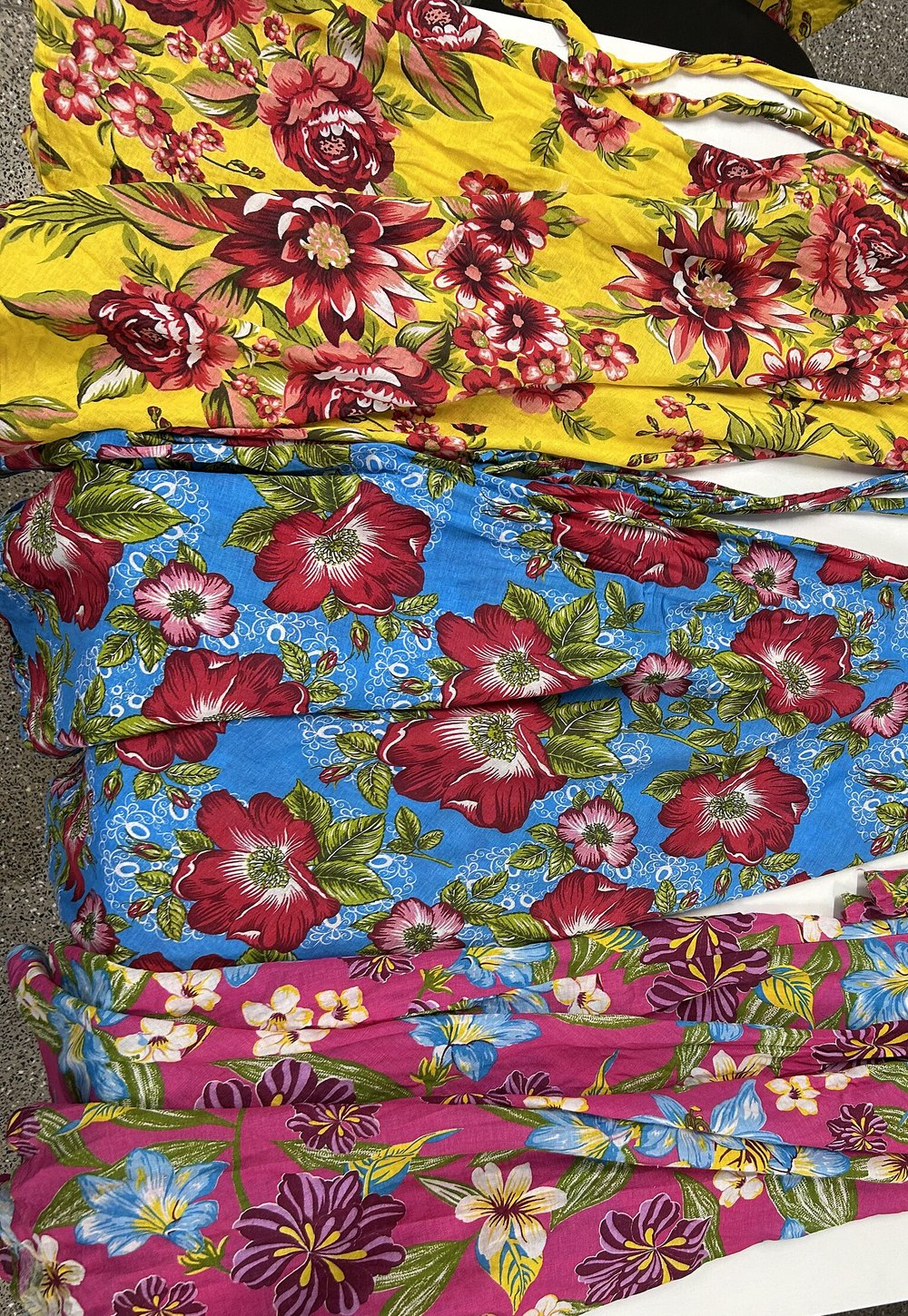
Three chita skirts laid out flat, with yellow, blue and pink grounds and large red and purple flowers.
Chita skirts for dancing the siriri. Photo: Jenniffer Coimbra Lemos de Souza, CC0, Wikimedia Commons.

Chita

The cloth that is now a symbol of Brazil was illegal to make in Brazil for 23 years.

The word comes from the Hindi “chint”, a spot, and the cloth comes from India too: a cotton painted and printed with dyes that do not run. Europe went mad for it. France and England even banned it by law.

On 5 January 1785, Queen Maria I of Portugal ordered the textile factories and looms of Brazil to be closed. The decree lists what was forbidden, and there it is by name: “Chitas”. Only coarse cotton was spared, the kind used to clothe enslaved people and to make sacks.

Read the whole story

The business lay elsewhere. According to the historian Jorge Pedreira, the chitas printed near Lisbon were already being exported to Brazil in 1777.

The ban lasted 23 years. On 1 April 1808, with the Portuguese court installed in Rio de Janeiro, the prince regent revoked it and allowed factories to open. By the 1820s Rio already had a Fábrica de Chitas, in what is now Saens Peña square.

It was cheap because its base is a plain cotton, and so it was the cloth of those who could afford no other. Chitão, the one with the enormous flowers, is far more recent: according to the authors of the book “Que Chita Bacana”, the name appears in the 1950s.

Today it dresses the June festivals, bumba meu boi and maracatu. In 2005 an exhibition in São Paulo put it on the catwalk with eleven designers, and in 2026 Brazil’s post office gave it a set of stamps.

Open this story

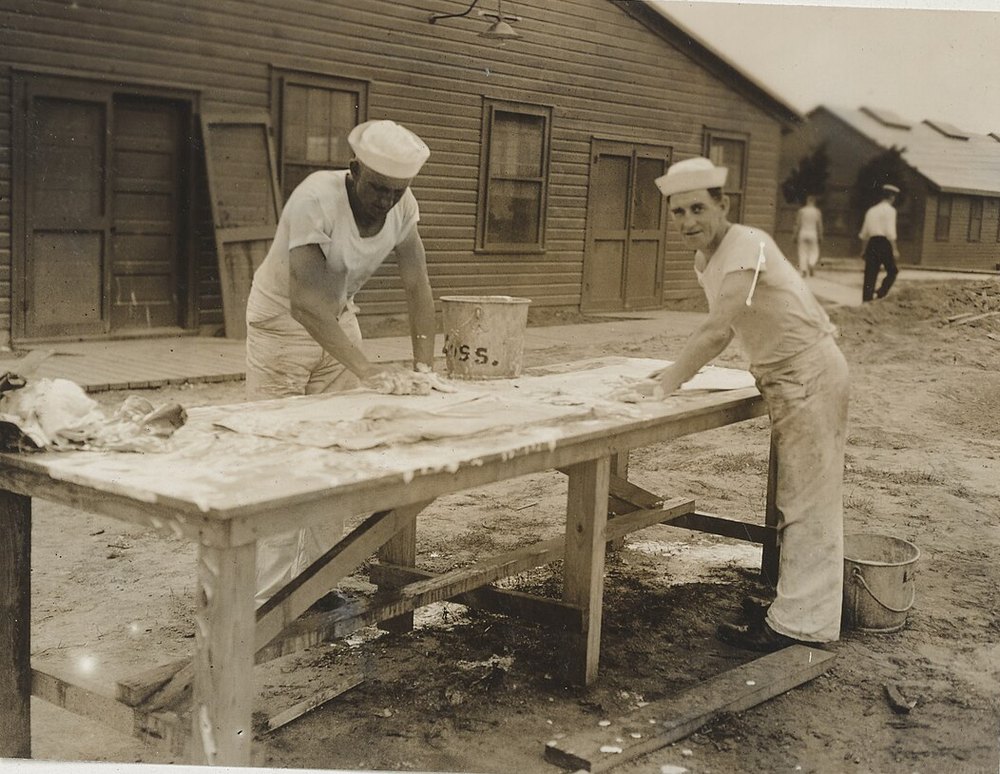
An old photograph: two sailors in caps and white short-sleeved undershirts scrub clothes on a table outdoors.
Sailors scrubbing their whites at Cape May, New Jersey, c. 1919. Committee on Public Information, US National Archives, public domain.

The T-shirt

The T-shirt was underwear, and the Navy only let it show on the high seas.

In 1913 the uniform regulations of the United States Navy describe a light undershirt: cotton, with no buttons and with sleeves “only long enough to cover the armpit”. It was meant to be worn underneath.

Sailors could strip down to the undershirt only at sea or in isolated anchorages, when the heat was fierce. It had to be clean, and by supper time the jumper had to go back on.

Read the whole story

The word dates from those years. The Oxford English Dictionary first finds it in print in 1912, in the Princeton students’ newspaper. It is usually credited to F. Scott Fitzgerald, who used it in a 1920 novel: he was eight years late.

In 1938 the Sears catalogue was selling a “gob style all purpose shirt”, a sailor-style shirt to wear underneath or on show. And on 13 July 1942 Life magazine put on its cover a serviceman in a T-shirt printed with the name of his gunnery school.

In 1948 the campaign of the Republican Thomas Dewey had its own T-shirt: “Dew-it with Dewey”. One is kept at the Smithsonian. Dewey lost.

What brought it out from under the shirt was the cinema: Marlon Brando in “A Streetcar Named Desire” in 1951, and James Dean in “Rebel Without a Cause” in 1955. Until then, most men still wore it underneath.

Open this story

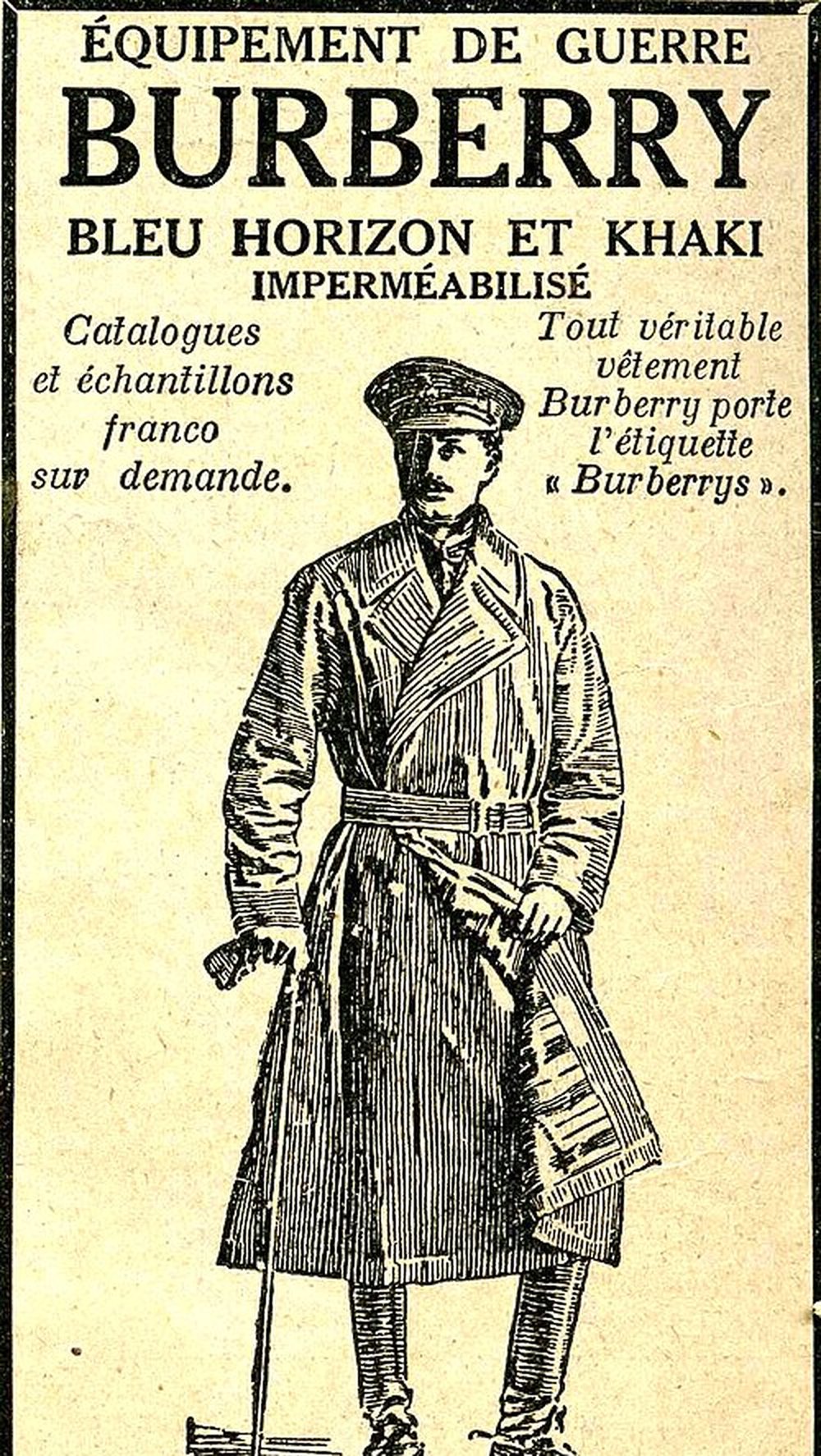
A 1917 advertisement in French: an officer in a cap, holding a cane, wears a belted double-breasted coat, the Burberry Tielocken.
Burberry advertisement in “La Vie parisienne”, 28 July 1917. Public domain, Wikimedia Commons.

The trench coat

The coat named after the trenches was forbidden to the soldiers in the trenches.

In the First World War the trench coat was not regulation issue. The ranks were given the army’s woollen greatcoat; officers paid for their kit out of their own pockets, and they were the ones who bought it. Private soldiers were not allowed to wear it.

The cloth came first. Thomas Burberry, who had kept a shop in Basingstoke since 1856, developed gabardine in 1879: a very tightly woven twill, waterproofed before weaving, that let the body breathe. The raincoats of the day were made of rubber.

Read the whole story

Two houses claim the invention. Aquascutum, opened in London in 1851, whose name means “water shield” in Latin, counts it among its firsts. Burberry patented the Tielocken in 1912, a double-breasted coat fastened with a belt and buckle. No independent source gives the credit to either.

And neither of them coined the word. “Trench coat” first appears in print on 19 December 1914, in an advertisement by Thresher & Glenny, a military tailor almost nobody remembers today.

The shoulder straps were for displaying rank and holding gloves. The D-rings on the belt were for hanging kit. That they were for grenades is often repeated, but it is not documented.

By August 1917 the New York Times was reporting that American officers were asking for the “British trench coat”. The war ended and the officers’ coat stayed on the street.

Open this story